






















Why Messi and Ronaldo Can Never Be Compared Fairly
Football has spent nearly two decades trying to answer one question:
Lionel Messi or Cristiano Ronaldo?
Goals are counted.
Assists are counted.
Trophies are stacked beside each other.
Ballon d’Or awards are compared.
Champions League nights are replayed.
International careers are dissected.
Then somebody declares the debate finished.
It never is.
The reason may be simpler than both fanbases want to admit.
Messi and Ronaldo were never really doing the same job.
They occupied the same era, competed for the same major prizes and became the two defining footballers of their generation.
But they reached greatness through almost opposite routes.
Messi became football’s ultimate creator who could also score at an absurd rate.
Ronaldo became football’s ultimate goalscoring machine after beginning his career as an explosive winger.
One manipulated matches through space, passing, dribbling and rhythm.
The other increasingly dominated them through movement, physical evolution, finishing and an extraordinary ability to appear where goals mattered most.
That is why the Messi vs Ronaldo comparison will always be compelling.
It is also why it can never be completely fair.
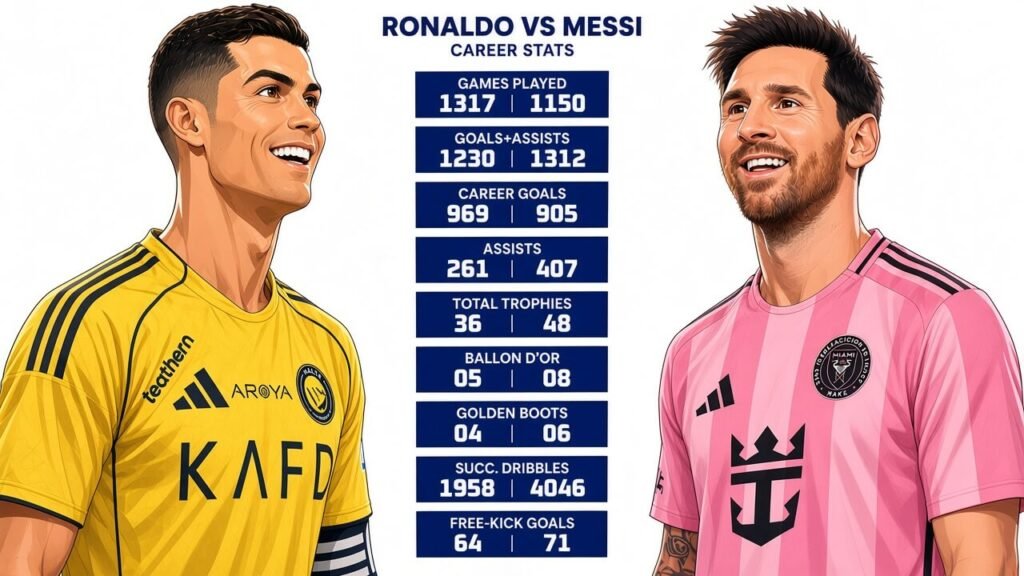
Messi vs Ronaldo Comparison: The Numbers Tell Only Part of the Story
| Category | Lionel Messi | Cristiano Ronaldo |
|---|---|---|
| Primary Career Identity | Creator, dribbler, scorer | Winger evolved into elite goalscorer |
| Champions League Goals | 129 | 140 |
| Champions League Hat-Tricks | 8 | 8 |
| Ballon d’Or Wins | 8 | 5 |
| International Legacy | World Cup winner and Argentina record scorer | Portugal record scorer and European champion |
| Signature Quality | Creating and finishing attacks | Finishing and attacking space |
| Peak Environment | Barcelona positional-possession system | Manchester United and Real Madrid transition/attacking systems |
| Career Evolution | Winger → false nine → playmaker | Winger → inside forward → centre-forward |
UEFA lists Ronaldo as the Champions League’s all-time leading scorer with 140 goals, ahead of Messi’s 129, while both share the competition record of eight hat-tricks. Messi remains the record eight-time Ballon d’Or winner; Ronaldo won the award five times.
Already, the problem with a simple comparison becomes obvious.
Which of those categories matters most?
There is no objective answer.
Messi Was Never Just a Goalscorer
One of the strangest consequences of Messi’s enormous scoring numbers is that they sometimes hide what made him extraordinary.
He was not built purely around goals.
Messi could receive in midfield, eliminate a defender, progress the ball, play the final pass and then arrive near the penalty area to finish the same move.
At his peak, he effectively combined several attacking jobs into one player.
That matters when evaluating his numbers.
A traditional forward can disappear from a match and still score twice.
Messi was often expected to help construct the attack before finishing it.
Opta’s long-term dribbling research shows the scale of his involvement: Messi recorded far more attempted take-ons than any comparable high-volume attacker in its study, with his dribbling repeatedly producing shots, chances and goals. At World Cups, Opta has also recorded him as one of the competition’s extraordinary progressive carriers and chance creators.
This is why measuring Messi only through goals is incomplete.
The goals were the ending.
Often, he had already created the beginning.
Ronaldo Reinvented Himself Instead
Ronaldo’s genius followed a different route.
The teenager who arrived at Manchester United was not the player who later destroyed Champions League knockout rounds for Real Madrid.
Early Ronaldo wanted the ball wide.
He dribbled.
He used stepovers.
He attacked full-backs.
He crossed.
Then his game changed.
The unnecessary touches gradually disappeared.
His movement became more direct.
His body became stronger.
His heading became devastating.
His positioning moved closer to goal.
Eventually, he became one of the most efficient penalty-area attackers football has ever produced.
That evolution is part of Ronaldo’s greatness.
He did not remain one kind of footballer for twenty years.
He rebuilt himself.
UEFA credits him with a competition-record 140 Champions League goals, including 67 in knockout matches, and a record 17 goals in the 2013/14 campaign. He also became the first player to score in three Champions League finals.
That is not merely longevity.
It is adaptation.
Messi Controlled Space Differently
Watch Messi without focusing on the ball and one detail becomes obvious.
He often walked.
That became one of the most discussed parts of his game.
But the walking was not necessarily inactivity.
Messi spent enormous portions of matches observing.
Where was the defensive midfielder?
Which centre-back would step forward?
Where was the full-back?
Which passing lane would appear if Barcelona moved the opposition five metres to one side?
Then he accelerated.
The contrast was devastating because defenders had spent several seconds believing nothing was happening.
Suddenly everything happened.
Messi’s football was based heavily on interpretation.
He did not simply attack space.
He often waited until he understood how the space would develop.
That type of influence is extremely difficult to quantify.
A goal can be counted.
A pass can be counted.
Understanding exactly why six defenders moved before the decisive pass is much harder.

Ronaldo Controlled Defenders Without Needing the Ball
Ronaldo’s off-ball influence worked differently.
Especially during his Real Madrid peak, defenders constantly had to know where he was.
His movement toward the back post became one of football’s most predictable actions.
And teams still struggled to stop it.
That sounds contradictory.
It is actually the definition of elite movement.
If everyone knows what is coming and it still works, the execution must be exceptional.
Ronaldo attacked the blind side.
He separated from centre-backs.
He delayed runs.
He accelerated across defenders.
And in the air, he became capable of finishing situations most forwards could barely reach.
His contribution increasingly happened in the spaces before the final touch.
That is why comparing Ronaldo’s touch count or passing volume with Messi’s can become misleading.
Ronaldo eventually designed his game around needing fewer actions to produce maximum damage.
Barcelona and Real Madrid Asked Different Questions
Another major problem with these debates is that players do not compete in laboratories.
They compete inside teams.
Messi’s greatest Barcelona sides were constructed around positional football.
Xavi controlled rhythm.
Andrés Iniesta broke pressure.
Sergio Busquets protected the structure.
Messi moved between midfield and attack, sometimes operating as a false nine and sometimes drifting from the right.
The system amplified his intelligence.
But Messi also amplified the system.
Real Madrid’s strongest Ronaldo sides often functioned differently.
They could dominate possession, but they were also devastating when matches became transitional.
Players such as Karim Benzema created space.
Ángel Di María, Gareth Bale, Luka Modrić, Toni Kroos and Marcelo helped move the ball into areas where Ronaldo could attack.
Again, the structure helped him.
And Ronaldo’s scoring changed what the structure could achieve.
Trying to remove either player from his tactical environment and compare raw output as though everything else were equal misunderstands football.
Their Champions League Legacies Tell Different Stories
Europe provides perhaps the strongest case for Ronaldo.
He remains the competition’s record scorer.
He scored more knockout goals than anyone.
He won five Champions League finals and produced repeated decisive performances during Real Madrid’s extraordinary European era.
Messi’s European career looked different.
He scored 129 Champions League goals in 163 matches and remains the competition’s record scorer in the old group-stage/modern league-phase portion with 80 goals.
One record rewards knockout destruction.
Another demonstrates extraordinary consistency.
Neither automatically settles the argument.
It depends on what the observer values.
International Football Made the Debate Even Messier
For years, international football was used against Messi.
Then Argentina won the Copa América.
Then the 2022 World Cup.
His international story changed dramatically.
By 2026, UEFA listed Messi as Argentina’s record holder for appearances and goals and noted his two World Cup Golden Balls. FIFA also recorded him breaking the men’s World Cup career scoring record during the 2026 tournament.
Ronaldo’s international achievement is different.
He became the highest-scoring men’s international footballer, with UEFA listing him at 146 Portugal goals in 2026, and he became the first man to score at six different World Cups.
Again, how do you score that fairly?
World Cup success?
International goals?
Tournament longevity?
Continental success?
There is no universal weighting system.
Ronaldo’s Greatest Argument Is Reinvention
Ronaldo succeeded across several football cultures.
Manchester United.
Real Madrid.
Juventus.
Portugal.
Later Saudi Arabia.
The tactical expectations changed.
His body changed.
His speed changed.
His position changed.
The goals continued.
That adaptability is one of the strongest arguments in his favour.
Plenty of great players decline when the physical qualities that made them special begin disappearing.
Ronaldo replaced some of those qualities with different ones.
The winger became a goalscorer.
The dribbler became a movement specialist.
The creator of chaos became the finisher of it.
That transformation deserves more respect than simply counting goals at the end.
Messi’s Greatest Argument Is Total Influence
Messi’s strongest case is almost the opposite.
At his peak, he did not need to choose between creation and scoring.
He did both.
He could dominate a game without scoring.
He could dominate a game while scoring three.
He could drop into midfield.
He could beat defenders individually.
He could play the final pass.
He could take the free-kick.
He could finish the move.
That breadth is why so many statistical categories struggle to fully describe his influence.
The astonishing part was not merely that Messi had several elite skills.
It was that so many of them existed simultaneously.
The Ballon d’Or Does Not End the Debate Either
Messi has eight Ballon d’Or awards.
Ronaldo has five.
That is a major advantage in individual recognition.
It still cannot function as mathematical proof.
The Ballon d’Or is voted on.
Its criteria, electorate and footballing context have changed over time.
Individual awards tell us how players were perceived during their careers.
They are important evidence.
They are not a scientific measurement of ability.
Football has never possessed one.
Different Peaks Can Both Be Historic
Perhaps this is where the entire argument goes wrong.
Football supporters often assume greatness must be exclusive.
If Messi is extraordinary, Ronaldo somehow needs to become less extraordinary.
If Ronaldo has the stronger record in one category, Messi’s achievements need to be minimised.
That is unnecessary.
Ronaldo’s peak can be historically great.
Messi’s peak can also be historically great.
They do not cancel each other out.
They demonstrate that football excellence can take radically different forms.
Why Statistics Will Never Completely Solve It
Statistics are essential.
They make lazy narratives harder.
But statistics depend on context.
Goals depend partly on position.
Assists depend partly on teammates finishing chances.
Possession numbers depend on tactical systems.
Dribbles depend on starting zones.
International trophies depend on national-team strength.
Champions League success depends on club quality.
Even longevity depends partly on injuries, tactical evolution and opportunity.
This does not mean statistics are useless.
It means they should answer specific questions.
Who scored more Champions League goals?
Ronaldo.
Who won more Ballon d’Or awards?
Messi.
Who scored more international goals?
Ronaldo.
Who has the stronger World Cup résumé?
Messi.
Those questions have measurable answers.
“Who was better at football?” is not the same kind of question.
Football Today Media Verdict
The greatest mistake in the Messi-Ronaldo debate is trying to force two completely different footballers into one definition of greatness.
Ronaldo was relentless evolution.
Messi was almost impossible natural completeness.
Ronaldo transformed himself into the greatest pure goalscorer of his era.
Messi became a playmaker, dribbler and goalscorer occupying the same body.
Ronaldo conquered matches through movement, timing, athleticism and finishing.
Messi manipulated matches through space, rhythm, technique and imagination.
One built part of his legacy around the Champions League knockout stage.
The other produced perhaps the broadest attacking skillset modern football has seen.
They shared an era.
They shared individual awards.
They shared El Clásico.
They shared the Champions League stage.
But they did not share the same footballing role.
That is why the Messi vs Ronaldo comparison will never disappear.
And it is also why it can never be completely fair.
Perhaps football does not need a final answer.
For almost twenty years, supporters were able to watch two players chase impossible standards in completely different ways.
The argument was never the greatest part of the rivalry.
Having both of them at the same time was.
Sources
UEFA — Cristiano Ronaldo Champions League Records
Official UEFA breakdown of Ronaldo’s 140 Champions League goals, knockout record, and five final victories.
UEFA — Lionel Messi Champions League Records
Official breakdown of Messi’s 129 Champions League goals and European competition records.
UEFA — Lionel Messi Career Records
Official overview of Messi’s club, international, and World Cup records.
UEFA — Cristiano Ronaldo Records
Official overview of Ronaldo’s Champions League, European, and international records.
UEFA — Ballon d’Or Winners
Historical list confirming Messi’s eight Ballon d’Or victories and Ronaldo’s five.
Opta Analyst — The Definitive Guide to Dribblers
Statistical analysis of Messi’s extraordinary dribbling volume and attacking impact.