

















Most football legends become inseparable from one club, one shirt or one rivalry. Ronaldo Nazário was different.
At his devastating best, the Brazilian striker seemed too extraordinary to belong to only one corner of European football. His career carried him through Barcelona, Inter Milan, Real Madrid and AC Milan — four giants divided by two of the fiercest rivalries in the game.
What makes the Ronaldo Nazário transfer history so fascinating is not simply the size of the clubs he represented. It is the path connecting them.
Barcelona to Inter.
Inter to Real Madrid.
Real Madrid to AC Milan.
By the end of his European career, O Fenômeno had worn the colours of both Barcelona and Real Madrid, then both Inter and AC Milan.
It was a transfer journey almost impossible to imagine for an ordinary footballer.
Ronaldo was never ordinary.

Ronaldo Nazário Transfer History at a Glance
| Year | Transfer | Reported/Recorded Fee |
|---|---|---|
| 1996 | PSV Eindhoven → Barcelona | €15 million |
| 1997 | Barcelona → Inter Milan | 48 billion Italian lire |
| 2002 | Inter Milan → Real Madrid | Approx. €45 million total value |
| 2007 | Real Madrid → AC Milan | €7.5 million |
The transfers were separated by injuries, World Cup glory, individual awards and changing stages of Ronaldo’s career. Yet together they tell the story of a player whose reputation repeatedly transcended football’s traditional boundaries.
Barcelona: One Season Was Enough to Shock Europe
Before there was Real Madrid, there was Barcelona.
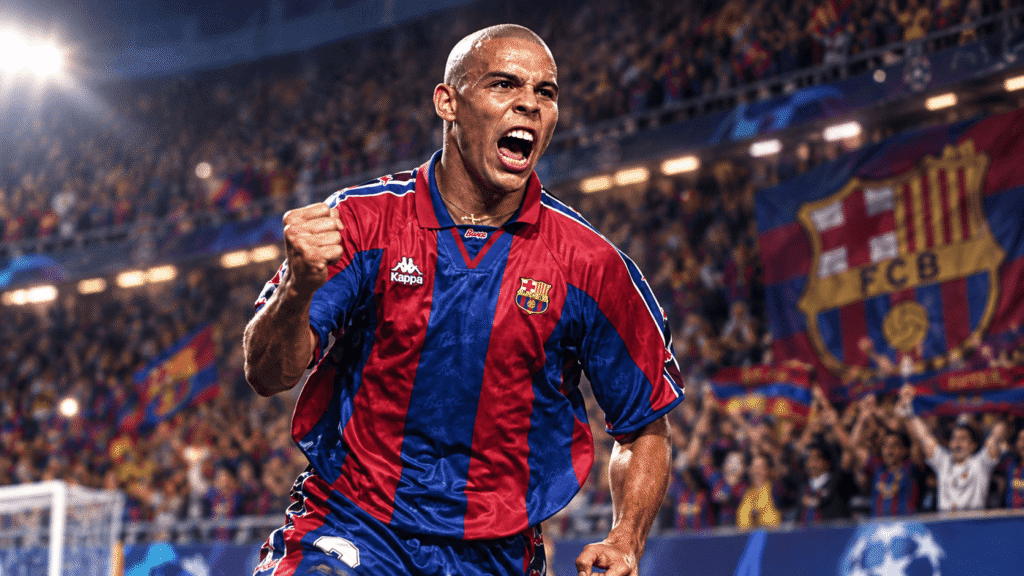
Ronaldo arrived in Catalonia from PSV Eindhoven in 1996 as one of football’s most exciting young forwards. What followed was not simply an impressive season. It became one of the defining individual campaigns of the 1990s.
He scored 47 goals in 49 appearances for Barcelona across all competitions, according to Inter’s historical account of his career. His acceleration, close control and extraordinary ability to stay on his feet while defenders desperately attempted to stop him made him appear almost impossible to contain.
Barcelona won the Copa del Rey, Spanish Super Cup and UEFA Cup Winners’ Cup during his only season at the club.
Ronaldo was still only 20.
For many players, that campaign could have been the beginning of a decade-long relationship with Barcelona.
For Ronaldo, it became the beginning of one of football’s most remarkable transfer stories.
Why Ronaldo Left Barcelona for Inter Milan
In the summer of 1997, negotiations surrounding Ronaldo’s future ultimately ended with his departure from Barcelona.
Inter moved aggressively.
The Italian club records the transfer at an enormous 48 billion lire, describing it as a record fee at the time. On 25 July 1997, Ronaldo arrived in Milan and was greeted by extraordinary excitement. Two days later, around 50,000 supporters attended San Siro for a friendly against Manchester United, with Ronaldo’s presentation becoming one of the main attractions of the evening.
Imagine the expectation.
Inter were not signing a promising striker.
They were signing the player increasingly viewed as the most devastating footballer on the planet.
And Italy was about to discover why he had earned the nickname Il Fenomeno — The Phenomenon.
Inter Milan and the Rise of Il Fenomeno
Serie A in the late 1990s contained elite defenders, tactical sophistication and some of the strongest teams in world football.
Ronaldo still found ways through.
His combination of explosive acceleration, strength, balance, dribbling and finishing made him exceptionally difficult to defend. He could attack open space like a sprinter, beat defenders from a standing position and finish chances with remarkable composure.
Ronaldo eventually made 99 appearances and scored 59 goals for Inter, helping the club win the 1997/98 UEFA Cup.
But the numbers alone cannot properly describe his Inter career.
It was also the period in which serious knee injuries changed his trajectory.
The player who once appeared physically unstoppable suddenly faced something defenders had failed to accomplish: his own body was preventing him from playing.
There were operations. Long recoveries. Doubts over whether the old Ronaldo would ever completely return.
Then came 2002.
And one of football’s greatest comeback stories.

The World Cup That Changed Everything Again
Ronaldo arrived at the 2002 FIFA World Cup with enormous questions surrounding his fitness and his ability to return to the highest level.
He answered them emphatically.
The Brazilian scored eight goals as Brazil won the tournament, completing one of the most powerful sporting comebacks of his generation.
Suddenly Ronaldo was not simply a former phenomenon attempting to rebuild his career.
He was a World Cup-winning superstar again.
And Real Madrid president Florentino Pérez was constructing a team designed around exactly that type of player.
Luís Figo was there.
Zinedine Zidane was there.
Roberto Carlos was there.
The Galácticos wanted Ronaldo next.

Ronaldo Nazário’s Transfer From Inter Milan to Real Madrid
The 2002 transfer saga became dramatic enough to match the player involved.
Ronaldo eventually completed his move from Inter to Real Madrid on 2 September 2002, shortly after leading Brazil to the World Cup.
UEFA reported the deal at an estimated value of around €45 million. The initial structure involved €35 million plus an agreement concerning another Real Madrid player or an additional payment, with FIFA later ordering Madrid to pay the extra €10 million after the player component was not completed.
It was another enormous move.
But this transfer carried an additional historical detail.
Five years after wearing Barcelona’s colours, Ronaldo was now becoming a Real Madrid player.
He had crossed Spanish football’s greatest divide.
Not directly from one club to the other, but dramatically enough for the connection to become an unavoidable part of his legacy.
From Barcelona Star to Real Madrid Galáctico
If anyone wondered whether Ronaldo could handle the pressure of the Santiago Bernabéu, his debut provided a quick answer.
Against Deportivo Alavés in October 2002, Ronaldo entered the game and scored within approximately a minute. He added another later in the match to complete a dream debut.
Real Madrid’s official records show Ronaldo finishing his spell with 104 goals in 177 appearances.
During his five seasons at the club, he won two La Liga titles, the Intercontinental Cup and the Spanish Super Cup. Individually, he also collected his second Ballon d’Or in 2002.
The frightening Barcelona youngster had become a global superstar in Madrid.
Yet Ronaldo’s journey across rivalries was still not finished.

From One Half of Milan to the Other — Via Madrid
January 2007 produced the next extraordinary chapter.
Ronaldo left Real Madrid and returned to the city where European football had once watched him become Il Fenomeno.
Only this time, he was not returning to Inter.
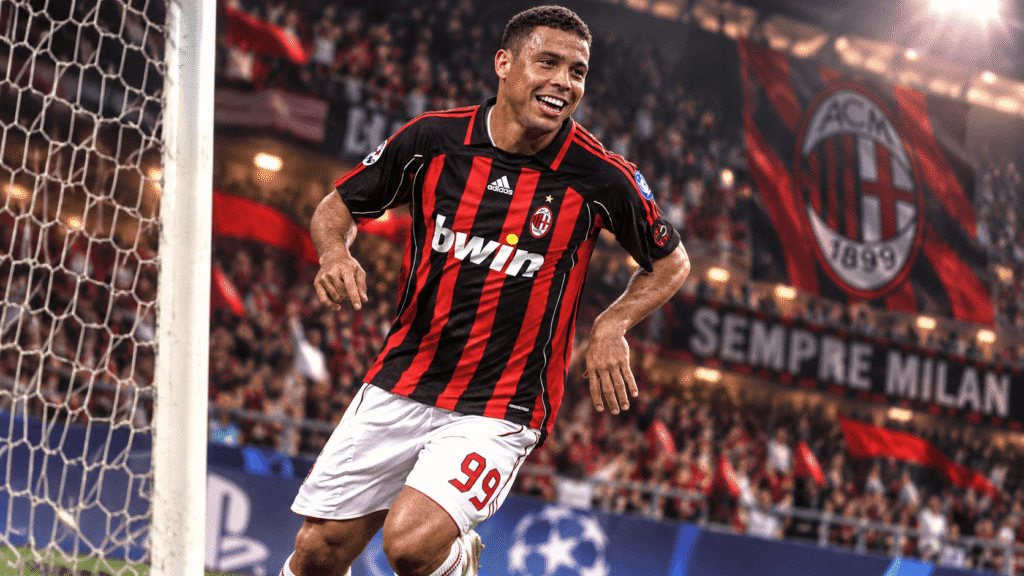
He was joining AC Milan.
UEFA confirmed Milan completed the transfer for €7.5 million, with Ronaldo agreeing a contract through June 2008.
The symbolism was impossible to ignore.
A former Inter icon was now wearing the red and black of their city rivals.
Years earlier, he had represented Barcelona before eventually joining Real Madrid.
Now history had produced another unusual symmetry: Inter and Milan.
Two countries.
Two enormous rivalries.
The same Ronaldo.
Ronaldo at AC Milan: The Phenomenon Had Changed
The Ronaldo who returned to San Siro in 2007 was not physically identical to the player who had electrified the stadium a decade earlier.
Years of injuries had taken something from his acceleration. His movement had changed. His body had changed.
His football intelligence had not disappeared.
AC Milan’s own historical retrospective notes that shortly after arriving from Real Madrid, Ronaldo had already produced three goals and two assists in his first eight appearances for the Rossoneri.
In his first Serie A start for Milan, away against Siena, he scored twice and supplied an assist in a 4-3 victory.
This was no longer the 20-year-old who could simply accelerate beyond an entire defensive line.
Instead, Milan briefly saw a more experienced version of Ronaldo — one who relied increasingly on positioning, technique, anticipation and finishing.
His spell would ultimately be limited by further injury problems.
But historically, the transfer completed something remarkable.
Ronaldo had now represented all four clubs.
Barcelona.
Inter.
Real Madrid.
AC Milan.
Why Ronaldo’s Transfer Career Was So Unusual
Modern football has seen countless superstar transfers, but Ronaldo’s journey feels different.
Players normally become heavily associated with one side of football’s great rivalries. Moving anywhere near the opposite side can permanently alter their relationship with supporters.
Ronaldo’s career somehow resisted such a simple definition.
Perhaps part of the reason was the uniqueness of the circumstances. He did not transfer directly from Barcelona to Real Madrid, nor did he move directly from Inter to Milan. Years, different clubs, injuries and dramatic changes in his career separated those moves.
More importantly, Ronaldo’s identity was larger than any transfer narrative.
At Barcelona, supporters remember a breathtaking young striker.
At Inter, they remember Il Fenomeno.
At Real Madrid, they remember a Galáctico.
At AC Milan, they remember the return of one of football’s greatest forwards to San Siro.
Different shirts.
Different versions of the same extraordinary player.

More Than a Transfer Story
The Ronaldo Nazário transfer history also reflects how quickly football changed around him.
At Barcelona, he was the unstoppable young prodigy.
At Inter, he became arguably the sport’s most feared individual attacker before devastating injuries interrupted his rise.
At Real Madrid, he arrived as a World Cup champion and global Galáctico.
At Milan, he returned as an older superstar attempting to prove that technique and instinct could survive even after explosive athleticism had begun to fade.
Each transfer introduced football to a different Ronaldo.
That may be why his career remains so fascinating decades later.
Football Today Media Verdict: A Career That Crossed Every Line
Football normally asks its greatest players to choose sides.
Ronaldo Nazário seemed to exist beyond them.
He became a hero at Inter after leaving Barcelona. He became a Real Madrid superstar after recovering from injuries that threatened his career. And finally, he returned to Milan wearing the colours of Inter’s greatest rival.
Barcelona and Real Madrid.
Inter and AC Milan.
Four of Europe’s most historic clubs connected by one extraordinary career.
Perhaps that is the most fitting way to understand Ronaldo.
The phenomenon was never defined by the shirt he wore. The shirts became part of the phenomenon.
Sources & Further Reading
Inter — “25 July 1997: Ronaldo joins Inter”
Inter’s official account of Ronaldo’s 1997 arrival, presentation and reception at San Siro.
UEFA — “Madrid seal Ronaldo deal”
Contemporary report covering Ronaldo’s transfer from Inter to Real Madrid and the structure of the agreement.
UEFA — “Madrid to pay extra for Ronaldo”
Report on FIFA’s ruling concerning the additional payment owed to Inter.
UEFA — “Ronaldo unveiled by Madrid”
Coverage of Ronaldo’s official Real Madrid presentation in September 2002.
UEFA — “Ronaldo unveiled by Rossoneri”
Contemporary confirmation of Ronaldo’s January 2007 transfer to AC Milan.