





























Football had experienced expensive transfers before Neymar.
Then Neymar moved to Paris.
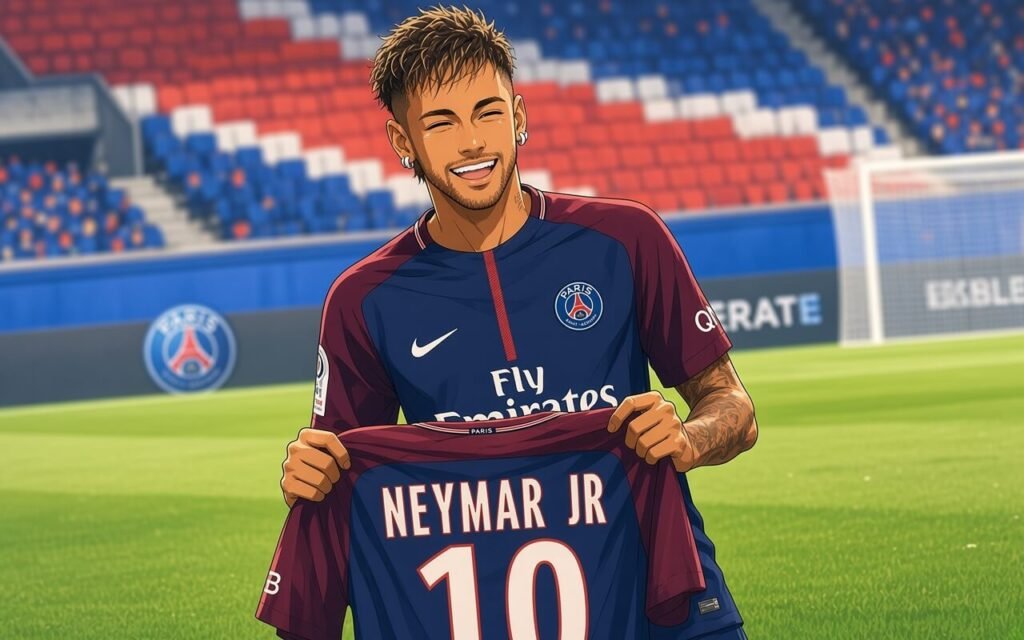
On 3 August 2017, Paris Saint-Germain completed one of the most disruptive transactions in football history by triggering the Brazilian’s €222 million release clause at Barcelona.
The number was almost absurd at the time.
Before Neymar, even the biggest transfers in world football generally operated around the €100 million mark. Suddenly, the record had not been beaten by €10 million or €20 million.
It had effectively been doubled.
That distinction matters.
Neymar’s move did not simply make one player more expensive than everyone else. It changed how clubs thought about the value of elite talent.
The transfer market already had inflationary pressures before 2017: Premier League broadcasting money was increasing, commercial revenues were rising and Europe’s richest clubs were becoming more financially powerful.
But Neymar’s transfer accelerated something deeper.
It changed the reference point.
From that moment onward, €100 million no longer sounded impossible.
For the best young attackers in Europe, it increasingly sounded like the beginning of a negotiation.
The Market Before Neymar
To understand the effect of Neymar’s transfer, it helps to remember what “expensive” meant before 2017.
Paul Pogba’s return from Juventus to Manchester United in 2016 had pushed the world-record transfer into roughly the €100 million range.
At the time, that already felt extraordinary.
A nine-figure transfer was still treated as an exception reserved for one of the most valuable players in world football.
Then PSG paid €222 million for Neymar.
That was not gradual inflation.
It was a market shock.
Reuters continues to recognise the deal as the world-record transfer fee, even after years of enormous spending across England, Spain, France and Saudi Arabia.
The previous ceiling had effectively disappeared.
When clubs negotiated after Neymar, they were no longer operating in the same psychological market.
Neymar Did Not Just Break the Record — He Broke the Scale
This is where the transfer becomes historically important.
Transfer fees are not determined purely through objective football value.
There is no mathematical formula proving that one winger is worth €80 million and another is worth €120 million.
Price is shaped by leverage.
Contract length.
Age.
Club wealth.
Replacement difficulty.
Commercial value.
And, perhaps most importantly, what the market has recently proven someone is willing to pay.
Neymar changed that final variable dramatically.
Once PSG demonstrated that a club could spend €222 million on one player, selling clubs had a new benchmark.
If Neymar was worth €222 million, why should an elite 20-year-old attacker be available for €60 million?
Why should a Champions League-level playmaker cost €70 million?
Why should a selling club accept yesterday’s prices when tomorrow’s buyer clearly had access to much more money?
The market began recalibrating.
Barcelona Suddenly Had €222 Million — and Everyone Knew It
The transfer had another major inflationary effect that is sometimes overlooked.
Barcelona became the richest desperate buyer in Europe overnight.
They had lost one of the three pillars of the famous Messi-Suárez-Neymar attack.
They needed a replacement.
They had enormous pressure from supporters.
And every selling club knew Barcelona had just received €222 million.
That is terrible negotiating leverage.
Within weeks, Barcelona agreed to sign Ousmane Dembélé from Borussia Dortmund for €105 million plus up to €40 million in add-ons. Barcelona officially confirmed those figures when announcing the transfer.
Dembélé was enormously talented.
But he was also only 20 years old and had spent a single season at Dortmund.
The important question is not whether he was talented enough to eventually justify a huge valuation.
The important question is whether Dortmund could realistically have demanded a package potentially reaching €145 million in the transfer environment of 2015.
Almost certainly not.
Neymar changed Barcelona’s position.
Dortmund knew they needed a winger.
Dortmund knew they had money.
And Dortmund knew the new market had just produced a €222 million player.
That combination was explosive.

Then Came Coutinho
Barcelona’s spending did not stop with Dembélé.
In January 2018, they finally completed the signing of Philippe Coutinho from Liverpool after pursuing him heavily the previous summer.
The Brazilian became another transfer in the enormous post-Neymar spending cycle.
Even without focusing solely on the final fee, the significance was obvious: Barcelona were attempting to replace Neymar’s lost creativity and attacking influence through multiple elite-level acquisitions rather than one direct replacement.
That is one of the hidden consequences of a record sale.
A club can receive a massive amount for one player and still end up spending even more trying to reconstruct what it lost.
Barcelona had received €222 million.
But once the market knew they possessed that money, every negotiation became more expensive.
The Neymar windfall was real.
So was the Neymar tax.
Mbappé Confirmed That €100m+ Was Becoming a New Reality
Perhaps the biggest proof that Neymar was not an isolated event came from Neymar’s own new club.
In the same summer, PSG acquired Kylian Mbappé from Monaco, initially through a loan arrangement that developed into a permanent transfer worth €180 million.
A later French court document confirmed the €180 million transfer amount.
Think about what had happened within one transfer cycle.
Football went from debating whether approximately €100 million was excessive for a superstar to witnessing:
Neymar — €222 million
Mbappé — €180 million
Dembélé — €105 million plus €40 million in variables
The entire top end of the market had shifted.
The extraordinary became less extraordinary.
That is what genuine market inflation looks like.
Not every player suddenly doubles in price.
Instead, the highest benchmark rises, and everyone below it starts renegotiating their position relative to that benchmark.

Why Young Players Became So Expensive
Neymar’s transfer also contributed to a change in how clubs valued potential.
Traditionally, record-breaking fees tended to be reserved for players already established among the best in the world.
After 2017, clubs increasingly became willing to pay enormous fees for what a player might become.
Dembélé was 20.
Mbappé was 18.
The logic changed.
If an elite young attacker could become a future Neymar-level player, paying €100 million early could be presented as an investment rather than reckless spending.
That thinking still shapes football.
Clubs are no longer paying exclusively for current production.
They pay for projected development, resale value, contract control and the fear that another rich club will buy the player first.
The market became as much about future scarcity as present ability.
Release Clauses Suddenly Looked Different
There was also a structural consequence.
Barcelona reportedly never expected Neymar’s €222 million release clause to be realistically activated when the contract was agreed.
Then PSG activated it.
After that, enormous release clauses became easier to understand.
Barcelona set Dembélé’s buyout clause at €400 million when he arrived.
Spanish clubs increasingly used gigantic clauses not as realistic valuations but as defensive mechanisms.
The lesson from Neymar was simple:
If you genuinely do not want a player bought, do not assume any seemingly ridiculous number is untouchable.
A release clause that looked impossible could suddenly become a transfer fee.

But Neymar Did Not Cause Everything
There is an important distinction here.
Saying Neymar caused all transfer inflation would be too simplistic.
Football was already becoming richer.
Premier League television contracts were increasing spending power.
Champions League revenues were growing.
Billionaire and state-backed ownership changed the financial capacity of certain clubs.
Commercial income became global.
Agents became more influential.
Player contracts became more sophisticated.
And scarcity at the elite level naturally pushed prices upward.
Neymar did not create those forces.
He became the event that exposed how powerful they had become.
That is why the transfer matters so much.
It was less the beginning of inflation than the moment inflation became impossible to ignore.
The Psychological Barrier Was Gone
This may ultimately be Neymar’s greatest impact on the market.
Before 2017, €100 million felt like a line football clubs were reluctant to cross.
After Neymar, that psychological resistance weakened dramatically.
A €70 million transfer could suddenly be described as reasonable.
An €80 million defender no longer sounded unimaginable.
A €100 million midfielder became possible.
A €120 million attacker could be justified as the price required to secure elite talent.
Once the market’s highest point jumped to €222 million, every number underneath it looked different.
That is basic anchoring psychology.
If the most expensive player costs €100 million, €80 million feels enormous.
If the most expensive player costs €222 million, €80 million suddenly feels comparatively ordinary.
Neymar became football’s new anchor.
The Effects Are Still Visible in 2026
Nearly a decade later, Neymar’s world record still stands.
But the wider market has continued moving upward.
FIFA reported that international transfer spending during the 2026 post-World Cup window reached approximately $9.89 billion, another record, with World Cup players alone generating more than $3.3 billion in fees.
A year earlier, FIFA had already recorded a then-record $9.76 billion in international transfer spending during the 2025 close-season window.
The extraordinary figures of 2017 have not disappeared.
Football has grown into them.
That may be the clearest evidence of Neymar’s historical importance.
His transfer looked completely irrational by the standards of the previous market.
The market eventually changed enough that it began to look less alien.
Was Neymar Actually Worth €222 Million?
This is where the debate becomes more interesting.
From a purely sporting perspective, PSG did not achieve the Champions League domination many expected when Neymar arrived.
Injuries repeatedly disrupted his seasons.
The club eventually moved into another era.
So was €222 million too much?
Perhaps.
But transfer value is not only measured by trophies.
Neymar immediately changed PSG’s global profile.
He became the face of the project.
He brought extraordinary commercial attention.
He helped establish PSG as a destination capable of taking a superstar directly from Barcelona at the peak of his career.
Most importantly for football history, the transfer changed what every elite club believed was financially possible.
That influence may outlast Neymar’s actual PSG career.
Football Today Media Verdict
Neymar did not invent football inflation.
But his €222 million transfer turned gradual inflation into a market revolution.
Before Neymar, the world transfer record sat around the €100 million level.
After Neymar, the idea of a €100 million player no longer felt absurd.
Barcelona’s response pushed Dembélé into a deal worth €105 million plus major add-ons.
PSG’s move for Mbappé eventually reached €180 million.
Selling clubs became more aggressive.
Buying clubs became more accepting of nine-figure prices.
Young players began being valued not only for what they were, but for what they might become.
And giant release clauses became less decorative and more defensive.
The transfer market would probably have become more expensive even if Neymar had stayed at Barcelona.
Television money, commercial growth and billionaire ownership were already pushing football in that direction.
But Neymar accelerated the process dramatically.
He did not simply become the most expensive player in football history.
He made everyone else more expensive too.
That is why the most important legacy of Neymar’s move to Paris may not be what happened at PSG.
It may be what happened to the price of football after he arrived.
Sources
Reuters — Neymar’s €222m Transfer Remains the World Record
Reuters continues to identify Neymar’s 2017 move from Barcelona to PSG as the highest transfer fee in football history.
Read Reuters’ transfer-record overview
FC Barcelona — Ousmane Dembélé Transfer Confirmed
Barcelona officially confirmed the fee as €105 million plus add-ons, with a €400 million release clause.
Read Barcelona’s official Dembélé announcement
FIFA / Reuters — Global Transfer Spending Reaches Record Levels
International men’s transfer spending reached another record after the 2026 World Cup, demonstrating how large the global market has become.
Read the Reuters report
Reuters — Transfer Record Overview
Read the Reuters analysis