













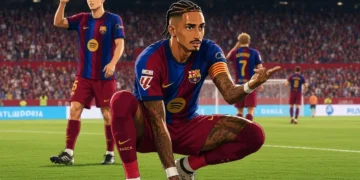










Barcelona received the news they feared when Raphinha was forced off at half-time during Brazil’s 4-2 victory over Australia.
Now they have received the first piece of encouraging news.
Medical imaging carried out by the Brazilian national team has detected a small muscular edema in the back of Raphinha’s right thigh, according to the Brazilian Football Confederation.
The forward has been withdrawn from Brazil’s remaining international fixture against India and will be released from the national-team camp to focus on his recovery.
So, how serious is the injury?
At this stage, the most accurate answer is:
It appears relatively minor — but Barcelona have good reason to be cautious.
There has been no announcement of a muscle tear.
There has been no multi-week recovery timetable.
And the CBF specifically described the edema as small.
However, the location matters.
Raphinha has suffered repeated problems involving his right thigh and hamstring over the past year, including an injury earlier in 2026 that sidelined him for approximately five weeks.
That history means Barcelona are unlikely to take unnecessary risks with one of their most important players.
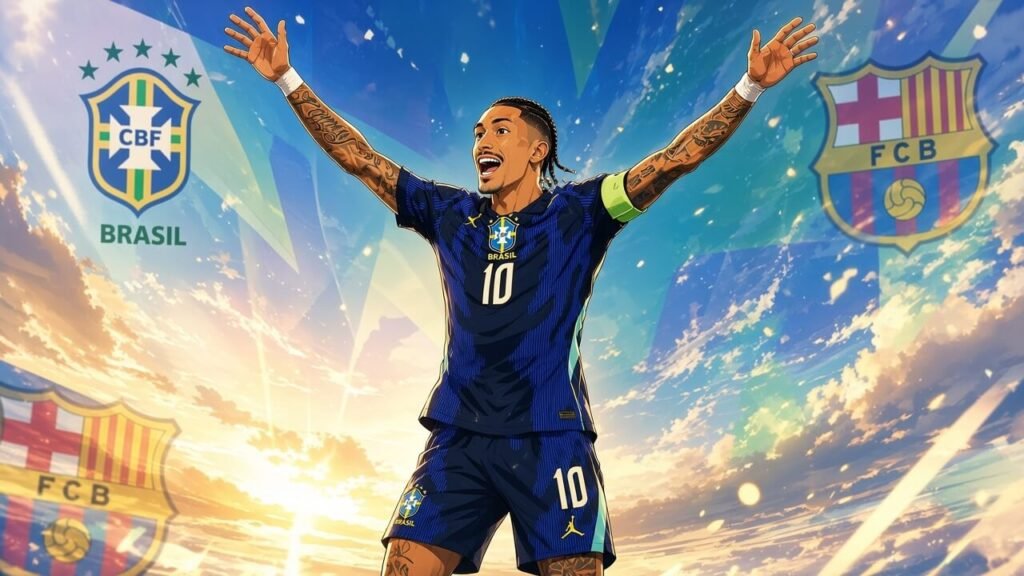
Raphinha Injury Update: What Exactly Happened?
| Injury Detail | Latest Information |
|---|---|
| Player | Raphinha |
| Club | FC Barcelona |
| Injury Area | Back of right thigh |
| Initial Symptom | Muscular discomfort |
| Scan Result | Small muscular edema |
| Match | Australia 2-4 Brazil |
| When He Left | Half-time |
| Brazil Status | Withdrawn from remaining international duty |
| Next Brazil Match | India – Raphinha will not play |
| Barcelona Return Date | Not officially confirmed |
| Current Severity | Appears minor based on initial diagnosis, but requires monitoring |
The key words are “small muscular edema.”
That diagnosis is far more encouraging than confirmation of a significant hamstring tear.
But it still represents an injury.
What Is a Muscular Edema?
A muscular edema essentially means there is fluid and inflammation within or around muscle tissue, usually after overload, irritation or minor structural stress.
Importantly, the CBF announcement has not described the problem as a major tear.
That distinction matters.
A significant hamstring tear can require several weeks — or considerably longer — depending on the grade and location.
A small edema can potentially settle much more quickly.
However, the exact recovery period depends on several factors:
The amount of muscle damage.
Whether Raphinha experiences pain while running.
How the muscle responds over the next several days.
Whether Barcelona’s own medical staff detect anything additional.
And, most importantly in this case, his previous injury history.
That means it would be irresponsible to guarantee a return date right now.
The Early Diagnosis Is Good News for Barcelona
When Raphinha failed to return for the second half against Australia, Barcelona supporters immediately had reason to worry.
His recent injury history is difficult to ignore.
But the current medical wording is encouraging.
The CBF did not announce a serious tear.
It did not describe the injury as severe.
Instead, imaging detected a small edema, and Brazil removed him from their next game as a precaution.
That suggests the decision is focused on preventing a minor problem from becoming something more serious.
For Barcelona, that is exactly what should happen.
There is little value in allowing Raphinha to play another international friendly if the muscle is already showing signs of stress.
How Did Raphinha Get Injured?
Raphinha started Brazil’s friendly against Australia in Brisbane.
He remained influential despite the injury scare.
The Barcelona attacker scored from the penalty spot shortly before half-time to make the score 2-2.
But during the opening half, he experienced discomfort in the back of his right thigh.
Brazil decided not to risk him after the interval.
Endrick replaced him.
Brazil eventually won 4-2 through second-half goals from Bruno Guimarães and Vinícius Júnior.
The result quickly became secondary from Barcelona’s perspective.
Their concern was Raphinha.
Why Barcelona Are Especially Cautious
This is not an isolated muscular problem.
That is the important context.
In March 2026, Raphinha suffered a right hamstring injury while playing for Brazil against France.
Barcelona subsequently announced an estimated recovery period of approximately five weeks.
That injury was serious enough to rule him out of major club fixtures.
Then came another problem during the 2026 World Cup.
Raphinha suffered another hamstring injury while representing Brazil and subsequently missed the national team’s final group match and knockout fixtures.
Barcelona’s official website later confirmed that the injury had prevented him from featuring in Brazil’s final games at the tournament.
Now, once again, the problem is located in the back of his right thigh.
That does not mean this injury is equally serious.
Current evidence actually suggests the opposite.
But repeated problems in the same general muscle region justify caution.
Is This Another Five-Week Injury?
At the moment, there is no evidence that it is.
That is an important distinction.
When Raphinha suffered his March injury, Barcelona specifically announced a right hamstring injury and gave an estimated five-week recovery period.
This time, the CBF has described the scan finding as a small muscular edema.
Those are not identical announcements.
Therefore, using his previous five-week absence as the expected timeline for this injury would be misleading.
Could further examinations reveal something more significant?
Yes.
But based strictly on the information currently available, the initial diagnosis is milder than Barcelona’s worst-case scenario.
When Could Raphinha Return for Barcelona?
This is where the timing becomes interesting.
Barcelona’s next competitive match is against Getafe on October 10.
That gives Raphinha approximately 10 days from the September 30 scan before Barça return to action.
After Getafe, the schedule becomes much more demanding:
October 10 — Barcelona vs Getafe
October 13 — Galatasaray vs Barcelona
October 17 — Real Betis vs Barcelona
October 20 — Paris Saint-Germain vs Barcelona
October 25 — Barcelona vs Real Madrid
That final fixture is obviously El Clásico.
For now, Barcelona have not officially ruled Raphinha out of any of those matches.
That means it would be too early to list Getafe — or any later fixture — as a confirmed absence.

Could He Play Against Getafe?
Possibly.
But that should not currently be treated as a certainty.
If the edema settles quickly and Raphinha returns to full training without pain, the 10-day gap gives Barcelona some recovery time.
However, Hansi Flick and the medical staff will also consider what comes immediately afterwards.
Barcelona face Galatasaray only three days after Getafe.
Then Betis.
Then Paris Saint-Germain.
Then Real Madrid.
That is an extremely demanding sequence.
Bringing Raphinha back too quickly for one league match would make little sense if doing so increased the risk of losing him for several weeks.
Therefore, even if he is medically close to returning against Getafe, Barcelona could choose a conservative approach.
The Champions League Changes the Calculation
The Galatasaray match on October 13 is particularly important.
Barcelona then travel to face PSG only one week later.
For a club targeting the Champions League, having Raphinha healthy for that sequence is far more important than rushing him through an early October league game.
And then comes El Clásico.
Barcelona host Real Madrid on October 25.
That gives Raphinha more than three weeks from the date of his scan.
Again, no medical guarantee can currently be made.
But nothing in the initial CBF diagnosis suggests Barcelona should already fear that he will automatically miss El Clásico.
That is encouraging.
Why Losing Raphinha Would Be a Huge Blow
The timing could hardly be worse from a sporting perspective.
Raphinha has started the season in extraordinary form.
Barcelona spent part of the summer exploring attacking options, but an internal solution emerged instead.
Hansi Flick moved Raphinha into a more central attacking role.
The result was devastating.
According to Reuters, Raphinha had scored 14 goals in Barcelona’s opening eight matches before the international break.
That includes 12 in LaLiga.
Those are centre-forward numbers from a player traditionally regarded as a winger.
He has become one of the most important attacking pieces in Flick’s system.
Raphinha’s Reinvention Makes His Absence Harder to Cover
Barcelona can replace Raphinha numerically.
Replacing what he currently gives them is much harder.
His role has evolved.
He can still drift left.
He can still create.
He can still press aggressively.
But he now attacks central scoring positions much more consistently.
That has transformed Barcelona’s attack.
Lamine Yamal can create from wide areas.
Karim Adeyemi can attack space.
Gabriel Jesus offers another central option.
But Raphinha’s combination of movement, finishing, pressing and positional intelligence has become unique within the squad.
His injury therefore arrives at exactly the moment when Barcelona have built enormous attacking momentum around him.
Flick’s Pressing System Also Needs Raphinha
His value is not limited to goals.
Raphinha has always been an aggressive presser.
That matters enormously under Hansi Flick.
Barcelona’s attacking structure relies on recovering possession quickly after losing it.
Raphinha understands when to jump toward centre-backs.
He understands passing triggers.
He tracks runners.
And he is willing to perform high-intensity defensive work even while carrying major attacking responsibility.
Losing him would therefore affect both sides of Barcelona’s game.
Goals disappear.
So does pressure from the front.
The Biggest Concern Is His Injury History
If Barcelona supporters are nervous, this is why.
The current diagnosis itself is relatively encouraging.
The history is not.
In February, Raphinha suffered a right adductor strain.
Barcelona estimated approximately one week of recovery.
In March, he suffered the more serious right hamstring injury against France.
Barcelona estimated five weeks.
Then another hamstring problem affected his World Cup.
Reuters reported in June that the World Cup setback represented his fourth hamstring issue in roughly a year.
Now another muscular problem has appeared in the back of his right thigh.
Individually, a small edema may not be alarming.
Collectively, the pattern deserves attention.
Barcelona Must Avoid Turning a Small Problem Into a Big One
This is the key point.
Barcelona’s objective should not simply be getting Raphinha available as quickly as possible.
It should be ensuring he is fully recovered.
Muscle injuries become especially problematic when players repeatedly return before they have restored full strength and tolerance to high-speed running.
Raphinha’s game requires explosive acceleration.
Pressing.
Repeated sprints.
Changes of direction.
Runs behind the defensive line.
Those movements place significant demand on the hamstring area.
Being capable of jogging or completing part of training therefore does not automatically mean he is ready for 90 minutes of elite football.
Barcelona must judge the risk carefully.
Brazil’s Decision Helps Barcelona
From Barcelona’s perspective, Brazil withdrawing Raphinha is unquestionably helpful.
The Seleção still have another friendly scheduled against India.
Raphinha could theoretically have remained with the squad and attempted to recover.
Instead, Brazil have removed that temptation completely.
He will not play.
No long-haul match preparation.
No additional competitive workload.
No risk of turning discomfort into something worse during another international friendly.
The focus now moves entirely toward recovery.
Should Barcelona Fans Be Worried?
Concerned?
Yes.
Panicked?
No.
Those are different things.
The repeated location of his muscle problems means Barcelona should monitor Raphinha very carefully.
But the actual medical information available on September 30 is relatively positive.
The scan detected a small muscular edema.
Not a confirmed major tear.
Not a severe rupture.
Not an injury accompanied by an official month-long recovery estimate.
That is why describing Raphinha as facing another lengthy absence would currently be premature.
What Happens Next?
The next important stage will be Barcelona’s own assessment.
Raphinha can return to his club, receive treatment and begin rehabilitation.
The medical staff will monitor pain levels and muscle response.
Then comes progression.
Individual work.
Running.
Higher-speed work.
Partial team training.
Full team training.
Only after he completes those stages without a setback should Barcelona consider putting him back into competitive action.
The first major checkpoint will naturally be the Getafe match on October 10.
Football Today Media Verdict
The initial fear was understandable.
Raphinha leaves Brazil’s match at half-time.
He is holding the back of his right thigh.
Barcelona remember what happened in March.
They remember the World Cup.
Another hamstring injury immediately looks possible.
But the first medical update is considerably more encouraging.
Scans have detected a small muscular edema in the back of Raphinha’s right thigh.
That is the key fact.
Brazil have removed him from the squad as a precaution.
He will miss the India friendly.
And Barcelona will now manage his recovery.
There is currently no official timetable for his return.
There is also currently no confirmation of a serious muscle tear.
That means the injury should be treated as a concern, but not a crisis.
Could Raphinha miss Barcelona’s first match back against Getafe?
Absolutely.
Could he return quickly if the muscle responds well?
Also possible.
What Barcelona should not do is rush him.
Their October schedule includes Galatasaray, Real Betis, Paris Saint-Germain and eventually Real Madrid.
Raphinha has become too important to risk turning a small edema into another five-week muscular injury.
The early diagnosis is good news.
The history demands caution.
Right now, Raphinha’s injury appears mild rather than severe.
But for Barcelona, the next several days will determine whether this is simply an international-break scare — or another interruption to the best form of his career.
Sources
Brazilian Football Confederation (CBF) — Raphinha Withdrawn From Brazil Squad
Official medical update confirming that imaging detected a small muscular edema in the back of Raphinha’s right thigh and that he has been withdrawn from the India friendly.
Reuters — Brazil Beat Australia as Muscle Issue Sidelines Raphinha
Match report confirms Raphinha experienced right-leg muscular discomfort and was replaced at half-time during Brazil’s 4-2 win.
FC Barcelona — Raphinha Injury News, March 2026
Barcelona’s official report on Raphinha’s previous right hamstring injury, which carried an estimated five-week recovery period.
Reuters — Raphinha’s World Cup Hamstring Setback
Background on Raphinha’s recurring hamstring issues and the right-thigh injury he suffered during the 2026 World Cup.
Reuters — Barcelona Embrace Raphinha’s New No. 9 Role
Background on Raphinha’s exceptional start to the 2026/27 campaign and his 14 goals in Barcelona’s opening eight matches.
FC Barcelona — First-Team Schedule
Official fixture schedule for Barcelona’s October matches against Getafe, Galatasaray, Real Betis, PSG and Real Madrid.