






























Five goals.
Twenty-four shots.
Seventy-two percent possession.
And another reminder that when Barcelona’s attack finds rhythm, stopping them can become almost impossible.
FC Barcelona opened its 2026/27 Champions League campaign with a devastating 5-1 victory over Feyenoord at the Spotify Camp Nou, combining overwhelming territorial control with moments of individual brilliance.
Raphinha scored twice.
Karim Adeyemi produced a spectacular finish.
Lamine Yamal scored a free-kick and created two more goals.
Gabriel Jesus came from the bench to score his first Barcelona goal.
Feyenoord eventually found a consolation through Sem Steijn, but by then the result had long been decided.
This was not simply a comfortable European victory.
It was the type of performance that sends an early message.
Barcelona want to go deep in this competition.
And on opening night, they played like a team capable of doing exactly that.
Barcelona vs Feyenoord: Match Snapshot
| Match Detail | Information |
|---|---|
| Final Score | FC Barcelona 5-1 Feyenoord |
| Competition | UEFA Champions League – League Phase |
| Date | September 9, 2026 |
| Venue | Spotify Camp Nou |
| Barcelona Scorers | Raphinha 3’, 57’; Karim Adeyemi 22’; Lamine Yamal 77’; Gabriel Jesus 85’ |
| Feyenoord Scorer | Sem Steijn 82’ |
| UEFA Player of the Match | Raphinha |
| Sofascore Highest Rating | Lamine Yamal – 10.0 |
| Possession | Barcelona 72% – 28% Feyenoord |
| Shots | Barcelona 24 – 4 Feyenoord |
| Shots on Target | Barcelona 9 – 2 Feyenoord |
| Expected Goals | Barcelona 1.63 – 0.52 Feyenoord |
| Final-Third Entries | Barcelona 84 – 17 Feyenoord |
| Key Tactical Theme | Barcelona suffocated Feyenoord through possession, pressing and constant width |
The statistical gap was enormous. Barcelona completed 747 of 793 passes, entered the final third 84 times and registered 45 touches inside Feyenoord’s penalty area.
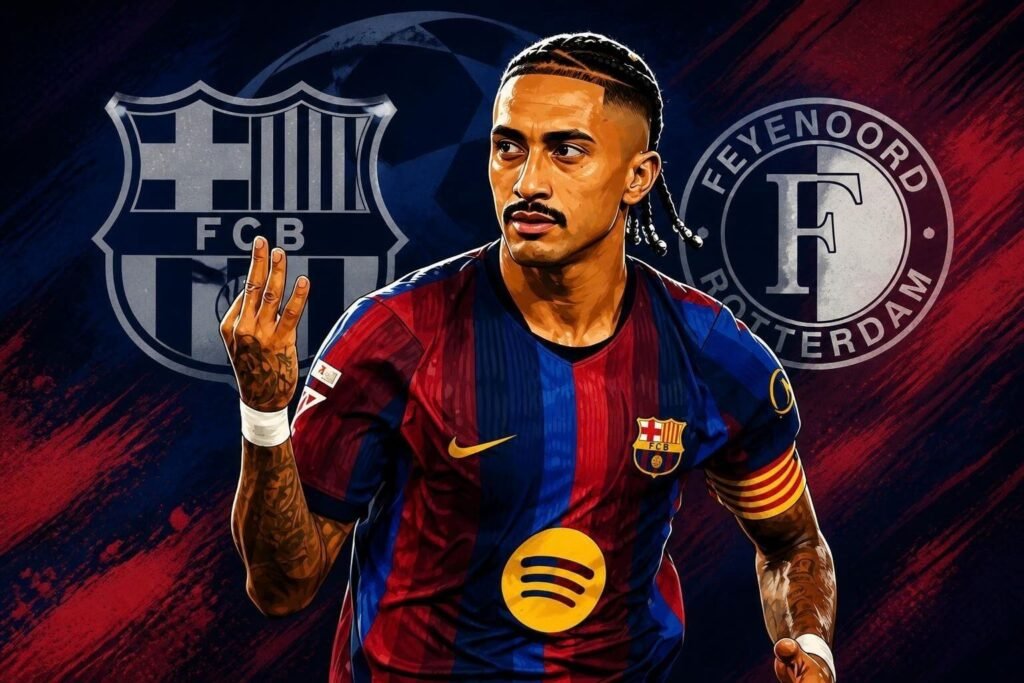
Three Minutes Was All Raphinha Needed
Barcelona did not spend the opening stages studying Feyenoord.
They attacked immediately.
Three minutes into the match, Lamine Yamal found Raphinha near the edge of the penalty area.
The Brazilian captain still had work to do.
He shifted his body.
Manipulated two defenders.
Created his shooting angle.
Then curled a controlled left-footed finish into the far corner.
Barcelona 1-0 Feyenoord.
The rain was pouring down at Camp Nou.
Barcelona were already flying.
It was also another reminder of Raphinha’s remarkable early-season form.
The Brazilian had now scored in every one of Barcelona’s opening five matches of the campaign.
Raphinha Is Becoming Something Bigger
The transformation of Raphinha deserves serious attention.
There was once a period when his long-term Barcelona future seemed uncertain.
Now he is captain.
A Champions League match-winner.
And one of the most productive attackers in European football.
His brace against Feyenoord took him to eight goals through Barcelona’s first five matches of the season.
According to Barcelona, no player had scored as many through the club’s opening five games since Sándor Kocsis in 1958/59.
Even more impressively, Raphinha reached 21 Champions League goals for Barcelona, moving fifth on the club’s all-time list in the competition.
Only Lionel Messi, Luis Suárez, Rivaldo and Robert Lewandowski stood above him at that point.
That is elite company.
Adeyemi Announces Himself in Europe
Barcelona’s second arrived after 22 minutes.
Karim Adeyemi received possession in the final third.
Feyenoord gave him a fraction too much room.
That was enough.
The German attacker drove inside before unleashing a superb right-footed strike beyond Tjark Ernst.
2-0.
It was Adeyemi’s first Champions League goal for Barcelona.
More importantly, it demonstrated another dimension of Hansi Flick’s attack.
Barcelona do not rely exclusively on Yamal or Raphinha to create separation.
Adeyemi’s direct running gives them a different weapon.
When defenders stay narrow to protect the middle, he can attack outside.
When they show him inside, he possesses the power to punish them from distance.
That variety makes Barcelona much harder to predict.
Feyenoord Could Not Escape Barcelona’s Control
The scoreline was already comfortable.
The territorial numbers were even more dominant.
Barcelona finished with 72% possession.
They attempted 793 passes.
Feyenoord attempted 307.
Barcelona completed 162 passes from 189 attempts in the final third alone.
Feyenoord managed only 17 final-third entries across the entire game.
That is not simply possession.
That is territorial suffocation.
Feyenoord spent huge periods defending rather than preparing attacks.
Every clearance created another Barcelona possession.
Every misplaced pass invited another wave.
And when the Dutch side attempted to run behind Barcelona’s high line, their timing consistently failed.
Feyenoord were caught offside eight times.
Barcelona were doing more than attacking well.
Their defensive line was actively destroying Feyenoord’s attacking rhythm.
Pedri Controlled the Centre
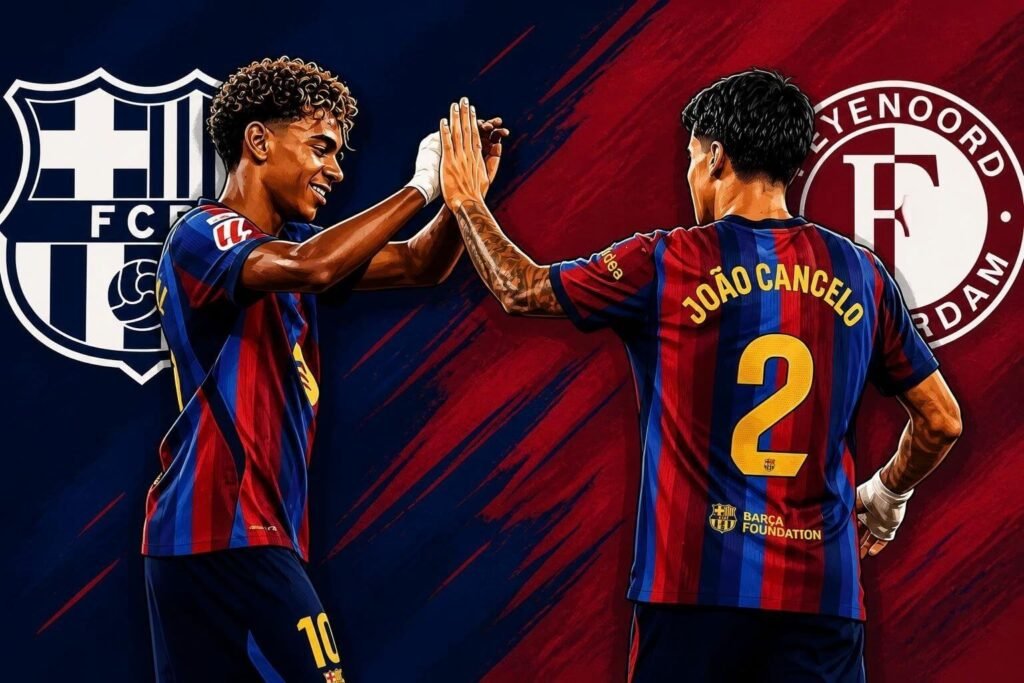
Amid all the attacking highlights, Pedri quietly gave Barcelona the platform to dominate.
His positioning was constantly available.
His passing controlled tempo.
And when Feyenoord attempted to press higher, Pedri helped Barcelona bypass the first wave.
Then came the decisive contribution.
In the 57th minute, he spotted Raphinha moving through the middle.
The pass was perfectly weighted.
Raphinha timed his run.
Controlled.
Finished.
3-0.
Game effectively over.
Pedri also completed all five of his attempted long passes according to Sofascore.
These details matter.
Barcelona’s attacking freedom exists partly because their midfield can consistently deliver the ball into the right areas.
Raphinha’s Movement Is Becoming Elite
His second goal highlighted how Raphinha’s role has evolved.
He is not simply standing wide and waiting to receive possession anymore.
He moves centrally.
Attacks spaces between centre-back and full-back.
Makes runs beyond the striker.
Drops into creative areas.
Then reappears inside the penalty area.
That unpredictability makes marking him extremely difficult.
Follow him inside and another Barcelona player occupies the wing.
Stay in your position and Raphinha attacks the gap.
Flick has effectively turned him into a hybrid forward rather than a traditional winger.
His scoring numbers suggest the change is working.
Feyenoord Thought They Had a Route Back
Shortly after Barcelona’s third, Nacho Ferri put the ball into the net.
For a moment, Feyenoord believed they had reduced the deficit.
The flag went up.
Offside.
No goal.
That moment captured the visitors’ frustration perfectly.
Even when they finally found space behind Barcelona, the timing was wrong.
The high defensive line survived again.
And Barcelona quickly returned to attacking.
Then Lamine Yamal Took Over
Raphinha had the goals.
Yamal may have produced the most complete individual performance.
Barcelona won a free-kick just outside the penalty area in the 77th minute.
Yamal stepped forward.
The teenager spotted the gap.
Low strike.
Goal.
4-0.
It was another extraordinary moment from a player for whom extraordinary moments are becoming strangely normal.
But concentrating only on the goal would underestimate his performance.
Sofascore recorded Yamal with:
One goal.
Two assists.
Four key passes.
One big chance created.
44 completed passes from 47 attempts.
12 duels won.
And a perfect 10.0 rating.
This was not a teenager producing one spectacular highlight.
This was a winger influencing almost every phase of the attack.
Yamal’s Ball-Carrying Was Devastating
One statistic illustrates the problem Feyenoord faced.
Yamal carried the ball 22 times for 189.3 metres, with more than 100 metres of progressive carrying.
That means he was not simply receiving possession high and attempting the final action.
He was transporting Barcelona up the pitch himself.
This is what separates truly elite wide players from ordinary wingers.
They do not wait for the game to arrive.
They move the game.
Yamal could start deeper.
Carry forward.
Commit defenders.
Then decide whether to shoot, combine or create.
Every option created another problem.
Feyenoord Finally Score
Barcelona did not leave with a clean sheet.
In the 82nd minute, Gonçalo Borges escaped down the flank and delivered into the area.
Sem Steijn arrived at the far post.
Finish.
4-1.
It was a well-constructed Feyenoord goal.
But there was little celebration beyond acknowledging that the visitors had finally beaten Joan García.
Barcelona’s four-goal advantage had become three.
For approximately three minutes.

Gabriel Jesus Needed Barely Any Time
Gabriel Jesus had just entered the match.
He was still waiting for his first Barcelona goal.
Yamal changed that.
The winger cut inside from the right and curled a beautiful cross toward the far side of the penalty area.
Jesus anticipated it.
Moved across his defender.
Got the slightest touch.
Goal.
5-1.
The Brazilian had been on the pitch for only a few minutes.
First Barcelona goal.
At Camp Nou.
In the Champions League.
For a new signing, there are far worse ways to open your account.
He nearly added another in the final action of the game when he struck the crossbar.
Barcelona Could Have Scored More
That sounds ridiculous after winning 5-1.
But it is true.
João Cancelo hit the post.
Yamal went close before scoring.
Jesus struck the crossbar late.
Barcelona recorded 24 shots and 45 penalty-area touches.
Their expected-goals total was only 1.63, which underlines just how exceptional some of their finishing was.
Five goals from 1.63 xG will not happen every week.
That should not diminish the performance.
Barcelona consistently reached attacking areas.
They consistently forced Feyenoord backwards.
And they possessed multiple players capable of converting difficult chances.
That is precisely what elite attacking sides do.
The Front Line Is Becoming Difficult to Predict
This may be Flick’s greatest advantage.
Who does the opponent prioritise?
Raphinha?
He scored twice.
Yamal?
He produced three direct goal contributions.
Adeyemi?
He scored.
Gabriel Jesus?
He came from the bench and scored almost immediately.
Even players who did not score were contributing to Barcelona’s territorial dominance.
The danger comes from everywhere.
This matters enormously in Europe.
The best Champions League teams eventually encounter opponents capable of removing Plan A.
Barcelona increasingly appear to have a Plan B, Plan C and perhaps more.
Flick’s Press Remains Central to Everything
Barcelona’s attacking numbers receive the attention.
Their defensive aggression makes much of it possible.
When Feyenoord recovered possession, Barcelona immediately attempted to win it back.
Adeyemi pressed.
Raphinha pressed.
The midfield closed passing lanes.
The defensive line pushed forward.
As a result, Feyenoord struggled to establish possession long enough to move Barcelona backwards.
Their 28% share of the ball was not purely voluntary.
Barcelona imposed it.
And once possession returned, the attack started again.
That cycle — attack, lose possession, recover possession, attack again — is central to Flick’s football.
Against Feyenoord, it worked almost perfectly.
Raphinha or Yamal: Who Was Actually Better?
There were two reasonable answers.
UEFA selected Raphinha as Player of the Match.
Two goals.
Captain’s performance.
Decisive when Barcelona needed him.
Sofascore gave Yamal a perfect 10, ahead of Raphinha’s 9.8.
One goal.
Two assists.
Four key passes.
A huge ball-carrying contribution.
There is no need to manufacture disagreement.
Barcelona had two world-class attacking performances on the same night.
That is precisely why Feyenoord could not cope.
Stop one.
The other hurts you.
The Bigger Champions League Question
Barcelona’s European ambitions will not be judged on Feyenoord alone.
They know that.
Champions League campaigns become progressively less forgiving.
The spaces become smaller.
The opponents become faster.
Defensive mistakes become more expensive.
But opening nights still matter.
They establish confidence.
They establish rhythm.
They allow new players to experience the competition without immediate pressure.
And they reveal whether the basic mechanisms of the team can translate from domestic football into Europe.
Against Feyenoord, they did.
Emphatically.
This Barcelona Team Is Playing With Freedom
Perhaps the most striking aspect was the confidence.
Raphinha taking defenders on before finishing.
Adeyemi shooting from distance.
Yamal demanding the free-kick.
Pedri attempting the decisive through ball.
Cancelo attacking the penalty area.
Jesus immediately trying to score after coming on.
There was very little hesitation.
That usually happens when players trust the structure around them.
Nobody appeared afraid of losing possession because the team believed it could recover the ball.
Nobody appeared reluctant to attack because movement around the ball created multiple options.
Flick has Barcelona playing aggressively.
When the technical quality matches that aggression, evenings like this become possible.
Football Today Media Verdict
FC Barcelona 5-1 Feyenoord was exactly how a Champions League campaign should begin.
Three points were expected.
The performance was the statement.
Barcelona did not merely defeat Feyenoord.
They overwhelmed them.
72% possession.
24 shots to four.
Nine shots on target to two.
84 final-third entries to 17.
45 touches inside the opposition penalty area.
Those are domination numbers.
Raphinha supplied the ruthlessness.
Two goals.
Another captain’s performance.
Another night that strengthens the argument that his transformation under Flick is one of Barcelona’s most significant developments.
Yamal supplied the imagination.
One goal.
Two assists.
A perfect Sofascore rating.
And at only 19, another European performance that already looked completely natural.
Adeyemi demonstrated why his directness adds another dimension.
Pedri controlled the midfield.
Gabriel Jesus introduced himself to Barcelona supporters with a Champions League goal.
There were imperfections.
Feyenoord scored.
Barcelona’s high line occasionally gave the visitors opportunities to run behind.
And five goals from 1.63 xG demonstrates finishing that will not always be repeatable.
But those are details Flick can analyse later.
Opening night was about establishing intent.
Barcelona did that.
Europe has learned many times that spectacular September football does not guarantee success in May.
The Champions League is too unforgiving for declarations after one match.
But Barcelona could only answer the question placed in front of them.
Feyenoord came to Camp Nou.
Barcelona dismantled them.
Five goals. Three points. One emphatic message.
Barça’s European campaign has begun.
And it has begun at full speed.
Sources
FC Barcelona — FC Barcelona 5-1 Feyenoord: Dancing in the Rain
Official match report covering the five goals, Raphinha’s brace, Adeyemi’s strike, Yamal’s free-kick and Gabriel Jesus’ first Barcelona goal.
FC Barcelona — Raphinha Continues to Make History
Official statistical feature covering Raphinha’s eight goals in five matches and his rise to fifth on Barcelona’s Champions League scoring list.
UEFA — Champions League Matchday 1 Wednesday Round-Up
Official UEFA report confirming the scorers and Raphinha as Player of the Match.
Sofascore — Barcelona 5-1 Feyenoord: Yamal Shines in UCL Opener
Detailed match data covering possession, xG, shots, final-third entries and Yamal’s perfect 10 rating.
Reuters — Barcelona Thrash Feyenoord in Champions League Opener
Independent Champions League round-up covering Barcelona’s 5-1 victory and Raphinha’s brace.