


























International football has entered one of those rare periods when everything seems to be changing at once.
One legend refuses to leave.
Another is preparing for his final night.
A World Cup hero has stepped away from his national team.
The United States is trying to turn one tournament into a lasting football culture.
Australia is confronting uncertainty around one of its most intriguing attacking talents.
And behind all of it, the 2026 World Cup has already changed the transfer market on a scale that can be measured in billions of dollars.
The international break approaching in late September is therefore about far more than Nations League fixtures or Africa Cup of Nations qualifiers.
It feels like the beginning of a transition.
Luka Modrić is staying. Edin Džeko is saying goodbye. Sofyan Amrabat has stepped aside. And a new generation is already fighting for the spaces they are leaving behind.
International Football Roundup: What Is Changing?
| Story | Current Situation | Why It Matters |
|---|---|---|
| Luka Modrić | Available for Croatia at 41 | One of international football’s great careers continues |
| Edin Džeko | Final Bosnia match scheduled against Sweden | Bosnia’s record scorer is ending a 19-year international career |
| Sofyan Amrabat | Unavailable for Morocco under current circumstances | A younger midfield generation is challenging an established World Cup hero |
| Mauricio Pochettino | Contracted with USA through 2030 | The project is shifting from one World Cup to long-term development |
| Cristian Volpato | Australia status under scrutiny amid an ongoing legal matter | A recently committed Socceroo faces uncertainty before the Asian Cup |
| Transfer Market | 267 World Cup players moved clubs | The 2026 tournament became a major catalyst for record transfer spending |

Luka Modrić Refuses to Close the Door on Croatia
Most football careers gradually disappear.
Luka Modrić’s appears determined to ignore the normal rules.
Croatia’s captain has confirmed that he remains available for international selection following the 2026 World Cup, ending speculation that the tournament would bring his extraordinary national-team career to a close.
Modrić turned 41 on September 9.
He has represented Croatia since 2006.
Opta lists him with 202 international appearances, 29 goals and 21 assists, while his international résumé includes Croatia’s remarkable run to the 2018 World Cup final and another deep tournament run four years later.
For most players, that would be more than enough.
For Modrić, apparently not.
Croatia’s returning coach Slaven Bilić made clear how valuable the decision was, saying the midfielder continues to bring something important both on and off the pitch. Modrić is available for Croatia’s upcoming Nations League programme, which includes major fixtures against England, Spain and the Czech Republic.
Why Modrić Still Matters
The simple explanation is that Croatia still do not have another midfielder exactly like him.
They have younger legs.
They have technically strong players.
They have footballers capable of carrying the national team into another cycle.
But replacing Modrić is not simply about finding someone who can pass.
His greatest quality has always been control.
When matches become frantic, Modrić slows them down.
When opponents press, he finds the angle nobody else sees.
When Croatia need possession to become meaningful rather than decorative, he still understands how to move a match from one phase into another.
His role may decrease.
His minutes probably should.
But there is an enormous difference between building a future without depending on Modrić and unnecessarily removing Modrić from that future.
Croatia appear to understand that.
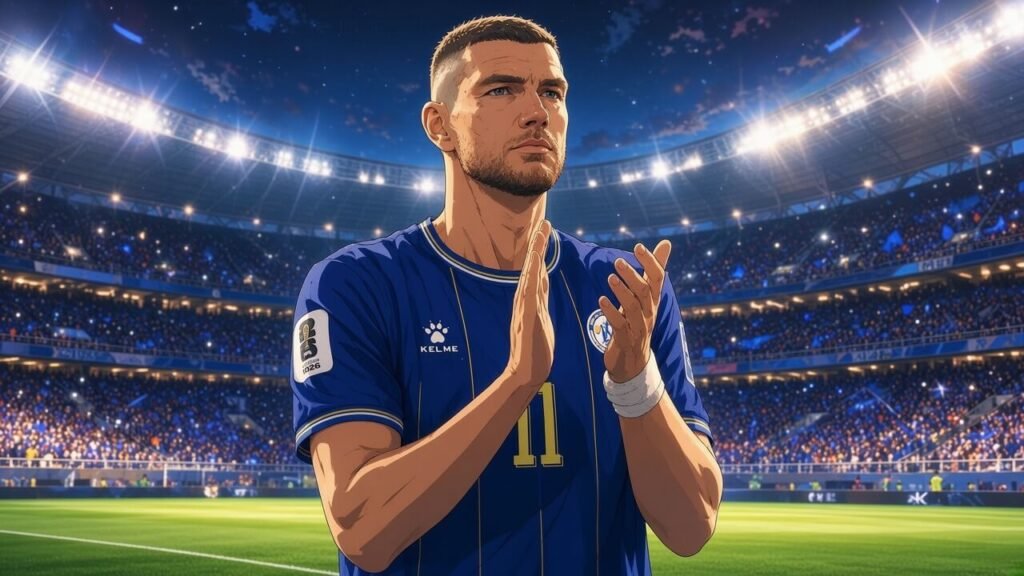
Edin Džeko Is Preparing for the Goodbye Bosnia Never Wanted
While Modrić continues, another Balkan legend has made the opposite decision.
Edin Džeko will end his Bosnia and Herzegovina career after the Nations League match against Sweden on October 2.
The striker is 40.
He made his international debut in 2007.
Reuters lists him at 151 caps and 73 goals, making him both Bosnia’s record appearance holder and record goalscorer.
Those numbers tell only part of the story.
For an entire generation, Džeko effectively became the face of Bosnian football.
He was there when Bosnia qualified for its first World Cup in 2014.
He remained long enough to help take the country back to the tournament in 2026.
FIFA highlighted his extraordinary longevity before this summer’s tournament, including his role in Bosnia’s dramatic qualification campaign. Bosnia then reached the round of 32 before losing 2-0 to the United States.
Bosnia Cannot Replace Him With One Player
This is the difficult part.
When an ordinary striker retires, a coach looks for another striker.
Replacing Džeko requires much more.
Bosnia must replace:
the goals.
the captaincy.
the reference point.
the player opponents identify first.
the personality teammates expect to lead them.
Those roles may eventually be divided between several younger players.
That is probably healthier anyway.
But Džeko’s farewell will represent more than a change at centre-forward.
It is the end of a national-team era.
For Bosnia supporters who grew up watching him score in Manchester, Rome, Milan, Istanbul and for the national team, October 2 will not simply be another Nations League fixture.
It will be goodbye.
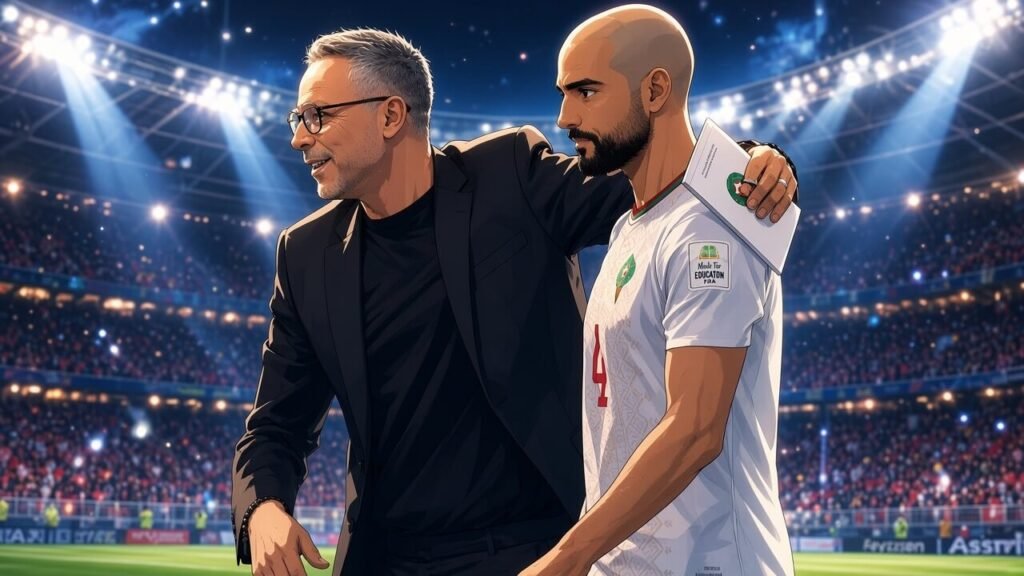
Sofyan Amrabat Walks Away — But Not Forever
Sofyan Amrabat’s situation is completely different.
The Morocco midfielder has not retired from international football.
He has instead made himself unavailable under current coach Mohamed Ouahbi, describing the reasons behind the decision as personal while leaving open the possibility of returning later.
That distinction matters.
Amrabat remains only 30.
This is not necessarily the end.
But it is still a remarkable development for a player who became one of the defining figures of Morocco’s historic 2022 World Cup run.
Back then, Amrabat seemed almost impossible to remove.
He covered enormous spaces.
Protected the defence.
Won second balls.
Carried Morocco through periods when possession belonged almost entirely to the opposition.
Four years later, his position has changed dramatically.
He started only one match at the 2026 World Cup, where Morocco eventually reached the quarter-finals.
Younger options, including Manchester City’s Ayyoub Bouaddi, have increasingly become part of the midfield picture.
Morocco’s Coach Has Made the New Reality Clear
Ouahbi has denied any personal conflict with Amrabat.
His explanation was arguably more significant.
Places must be earned.
Past achievements do not guarantee current selection.
That is exactly the type of decision coaches eventually have to make after successful tournament cycles.
The players responsible for yesterday’s history cannot automatically own tomorrow’s team.
For Amrabat, that can understandably be difficult.
For Morocco, it may be necessary.
Their 2022 generation changed expectations permanently.
Now the challenge is preventing respect for that generation from becoming dependence on it.

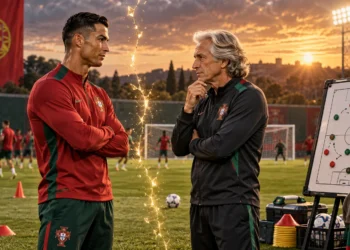
Pochettino’s American Project Is Now Bigger Than 2026
Mauricio Pochettino was initially hired with an obvious mission.
Prepare the United States for a home World Cup.
That tournament is over.
The project is not.
After the Americans reached the round of 16 before losing 4-1 to Belgium, U.S. Soccer extended Pochettino’s contract through the 2030 World Cup.
That decision fundamentally changes his job.
The objective is no longer simply producing a competitive tournament team.
It is building something sustainable.
His September squad offered an early indication of that shift.
The group includes 13 uncapped players, while several established stars are absent. Pochettino has described the post-World Cup period as the beginning of a different cycle focused heavily on evaluation.
Pochettino Wants More Than Better Players
The most interesting part of his American experience has been his discussion of culture.
Earlier in 2026, Pochettino argued that the United States still lacks the kind of deep emotional relationship with soccerfound in countries such as Argentina.
His argument went beyond professional academies.
He talked about children needing accessible places to play.
Unstructured football.
Local environments where the game becomes part of everyday life rather than an expensive scheduled activity.
That might be more important than any formation Pochettino uses.
The United States already has money.
Facilities.
Athletes.
A massive population.
A growing domestic league.
What it has historically lacked is the football ecosystem where talent emerges almost accidentally because children are surrounded by the game.
One World Cup cannot create that.
The next four years might begin to.

Cristian Volpato’s Australia Future Is Under Pressure
Few international careers changed as quickly as Cristian Volpato’s.
The Sydney-born attacker represented Italy at youth level before switching allegiance to Australia immediately before the 2026 World Cup.
He made his Socceroos debut on June 7 against Switzerland and has four senior appearances.
Within months, however, his immediate national-team future became uncertain.
NSW Police said a secondary oral-fluid test following a July traffic stop returned positive for cocaine. Volpato has maintained that he never knowingly ingested the substance, while his representatives have pointed to separate negative tests. He has elected to challenge the matter in court. Football Australia has said the process remains ongoing and has avoided prejudging the outcome.
That procedural context is important.
This is an ongoing legal matter, not something that should be treated as resolved.
Why It Matters for Australia
The timing is difficult.
Volpato only recently committed to the Socceroos after years of uncertainty around whether he would represent Australia or Italy.
His technical profile also makes him particularly interesting.
Australia traditionally produce intensity, physical strength and disciplined tournament sides.
What they have often wanted more of is exactly what Volpato potentially offers:
creativity between the lines.
Close control.
Unpredictability.
One-vers-one quality.
Australia now have to balance that sporting value with their own disciplinary processes and the ongoing legal proceedings.
Until those processes conclude, his international future remains uncertain rather than settled.

The World Cup Has Already Changed the Transfer Market
The largest story may actually involve none of these players individually.
The 2026 World Cup has changed the transfer economy.
FIFA’s post-window transfer report found that 267 players from 47 nationalities who appeared at the World Cup changed clubs during the summer window.
Those deals represented more than $3.3 billion in combined transfer fees.
The overall market was even bigger.
Men’s professional football recorded more than 12,500 international transfers during the mid-year window, with spending exceeding $9.89 billion — records for both volume and expenditure.
Those numbers make something clear.
The World Cup is no longer simply a sporting competition followed by the transfer window.
It is part of the transfer window.
Six Matches Can Change a Career
Scouting has become extraordinarily sophisticated.
Clubs have enormous databases.
Recruitment departments can study thousands of minutes.
A player’s physical output, passing patterns and pressure data can be examined without leaving an office.
And yet the World Cup still possesses something data cannot completely reproduce.
Pressure.
Can a player perform with an entire country’s expectations attached?
Can he adapt against unfamiliar tactical systems?
Can he survive knockout football?
Can he perform when there is no ordinary league match next week to correct the mistake?
A strong World Cup therefore changes perception.
It can turn a promising player into an urgent target.
The 2026 transfer figures show that clubs were watching.
Dual Nationals Are Becoming Even More Important
Cristian Volpato is not the only example of another major trend.
International football is increasingly becoming a recruitment contest.
Players with multiple nationalities are being approached earlier.
Federations are explaining development plans.
Coaches are maintaining direct contact.
And decisions once treated almost entirely as questions of birthplace are becoming much more complex.
The United States recently lost another of those battles when Noahkai Banks chose Germany despite previously representing the U.S. at youth level and attending an American senior training camp.
That is modern international football.
National teams are not only selecting.
Increasingly, they are recruiting.
International Football Is Entering a New Era
Put all these stories beside each other and a pattern appears.
Modrić represents the generation refusing to disappear.
Džeko represents the generation finally accepting that it must.
Amrabat represents players discovering that past international status no longer guarantees future importance.
Volpato represents the increasingly complicated world of dual-national recruitment and modern disciplinary scrutiny.
Pochettino represents a federation trying to transform one successful generation into an entire football culture.
The transfer market shows the enormous economic power international tournaments still possess.
These are not disconnected stories.
They are different parts of the same transition.
The 2026 World Cup ended in July.
Its consequences are only beginning.
Football Today Media Verdict
International football is often discussed as though it exists in four-year cycles.
World Cup.
Reset.
World Cup.
The reality is far more complicated.
The months immediately after a major tournament can be the moment when national teams change most dramatically.
Legends decide whether they have another campaign left.
Coaches decide which reputations still matter.
Young players choose countries.
Federations reassess entire development systems.
Clubs spend billions based partly on what they have just witnessed.
That is exactly what is happening now.
Luka Modrić is still there at 41 because Croatia believe he can still help.
Edin Džeko has decided one final Bosnia match is enough after 151 caps and 73 goals.
Sofyan Amrabat has stepped away because Morocco’s midfield hierarchy has changed.
Mauricio Pochettino is beginning another four-year project with an American squad becoming younger almost immediately.
Cristian Volpato faces uncertainty just months after finally choosing Australia.
And across the club game, more than $3.3 billion has been attached to transfers involving footballers who appeared at the World Cup.
International football is not waiting for the next tournament to begin changing.
The change has already started.
Some legends are holding on.
Some are walking away.
And behind them, the next era is already arriving.
Sources
Reuters — Luka Modrić Remains Available for Croatia
Confirmation that Modrić will continue his international career and is available for Croatia’s Nations League fixtures.
Reuters — Edin Džeko to End Bosnia Career
Confirmation that Džeko’s final international match is scheduled against Sweden on October 2.
Reuters — Sofyan Amrabat Steps Away From Morocco
Details of Amrabat’s decision to make himself unavailable while leaving open a possible international return.
Reuters — Morocco Coach Responds to Amrabat Situation
Mohamed Ouahbi explains that there is no personal rift and that selection is based on current merit.
Reuters — Mauricio Pochettino Extends USA Contract Through 2030
Confirmation of Pochettino’s long-term continuation with the United States.
ABC Australia — Cristian Volpato Legal Case and Socceroos Uncertainty
Reporting on the ongoing matter, Volpato’s position, and Football Australia’s response.
FIFA — World Cup 2026 Impact on the Transfer Market
Official FIFA transfer report confirms 267 World Cup players moved clubs in deals worth more than $3.3 billion.