


























Erling Haaland did not score in the first half.
He probably should have scored more than once.
Diogo Costa denied him.
Porto frustrated Manchester City.
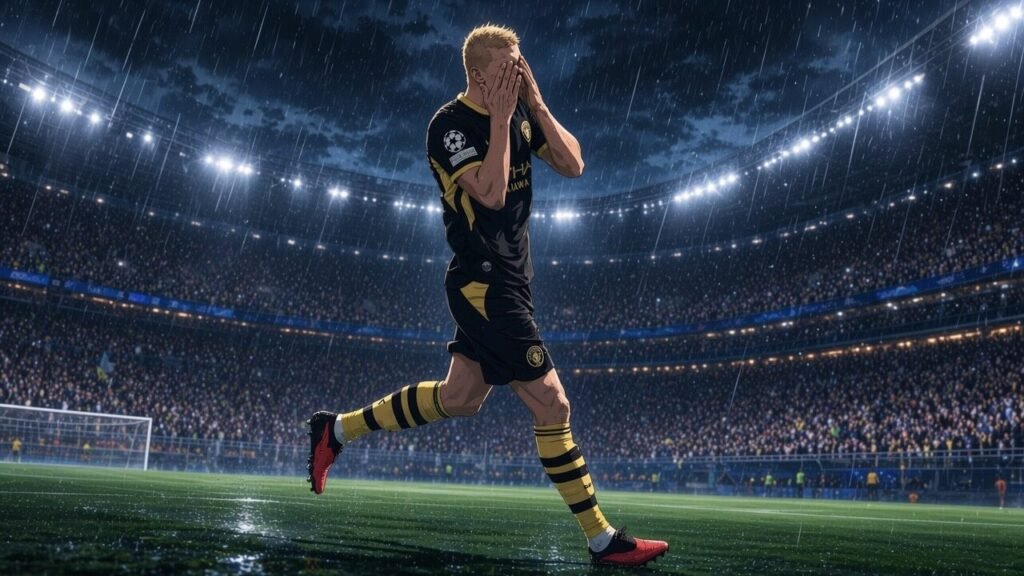
The rain continued to fall over the Estádio do Dragão.
Then the second half started.
Less than two minutes later, Haaland scored.
By stoppage time, he had another.
Manchester City 2. Porto 0.
A potentially uncomfortable Champions League away night had become another demonstration of why Haaland remains one of the most destructive forwards European football has ever seen.
City opened their 2026/27 Champions League campaign with a 2-0 victory in Portugal on September 8, giving Enzo Maresca three points in his first European match as Manchester City manager. Haaland struck in the 47th and 91st minutes, taking his extraordinary Champions League record to 59 goals in 59 appearances.
But the result was about more than the Norwegian.
City controlled possession.
They produced chance after chance.
Porto failed to register a single shot on target.
And after a first half in which Costa repeatedly kept the hosts alive, City eventually converted superiority into a result that accurately reflected the balance of the contest.
Porto vs Manchester City: Match Snapshot
| Match Detail | Information |
|---|---|
| Final Score | Porto 0-2 Manchester City |
| Competition | UEFA Champions League – League Phase |
| Date | September 8, 2026 |
| Venue | Estádio do Dragão |
| Scorer | Erling Haaland 47’, 90+1’ |
| Player of the Match | Erling Haaland |
| Possession | Porto 36% – 64% Manchester City |
| Shots | Porto 5 – 20 Manchester City |
| Shots on Target | Porto 0 – 10 Manchester City |
| Expected Goals | Porto 0.22 – 2.31 Manchester City |
| Corners | Porto 2 – 5 Manchester City |
| Key Tactical Theme | City controlled territory, pinned Porto back and attacked repeatedly through combinations around Haaland |
| Major Statistic | Haaland reached 59 Champions League goals in 59 appearances |
UEFA named Haaland Player of the Match after his decisive second-half double.
Porto Made City Work for It
The final score suggests a comfortable evening.
The first half did not feel that way.
Porto entered the match carrying an imposing home record. Manchester City’s official report noted that the Portuguese side had gone 33 matches unbeaten at the Dragão before City arrived.
The atmosphere reflected it.
Porto defended aggressively.
Duels were physical.
Spaces around the penalty area disappeared quickly.
And although City controlled possession, the opening stages were relatively slow.
Then the opportunities started arriving.
Antoine Semenyo began finding space.
Phil Foden moved into dangerous positions.
Rayan Cherki became increasingly involved.
Most importantly, Haaland started receiving chances inside the area.
That is usually when the opposition is in trouble.

Diogo Costa Delayed the Inevitable
Porto goalkeeper Diogo Costa was arguably the main reason the match remained goalless at half-time.
Haaland saw a powerful header stopped.
Another excellent opportunity was denied.
Cherki followed up one Haaland effort, only for Costa to recover and make another impressive save.
Foden was also frustrated.
City were creating enough to lead.
They simply were not finishing.
Opta recorded City finishing the night with 20 shots, 10 on target and 2.31 expected goals, compared with Porto’s five attempts and only 0.22 xG.
The score remained 0-0.
The underlying game did not.
City had already begun taking control.
Haaland Needed 107 Seconds After Half-Time
Porto survived 45 minutes.
They could not survive two more.
City restarted with urgency.
Foden drove forward.
Cherki helped keep the attack alive.
Enzo Fernández received the ball and clipped a delivery into the penalty area.
Haaland moved.
Header.
Inside the post.
1-0.
Manchester City’s official report places the goal in the 47th minute and details the sequence involving Foden, Cherki and Fernández before Haaland’s finish. Opta likewise credits Fernández’s delivery.
It was classic Haaland.
There was no need for five touches.
No elaborate dribble.
No spectacular skill.
Movement.
Timing.
Contact.
Goal.
That simplicity is what makes him so difficult to defend.
The Most Dangerous Thing About Haaland Is Repetition
Defenders know what he wants.
It rarely matters.
Haaland wants space between centre-backs.
He wants deliveries across the six-yard area.
He wants defenders facing their own goal.
He wants early crosses before the defensive structure can settle.
Everyone knows this.
Yet he continues scoring.
The reason is not mysterious.
Elite movement operates faster than defensive recognition.
A centre-back can understand exactly where Haaland wants to move and still react half a second too late.
At Champions League level, half a second is enormous.
Against Porto, the first goal changed the entire match.
The hosts could no longer simply defend their structure.
They had to become more aggressive.
That created more space for City.

Porto Had Their Best Spell After Conceding
To Porto’s credit, they responded.
Alberto Costa sent a header across goal.
Alan Varela curled an effort narrowly wide.
William Gomes nearly punished Gianluigi Donnarumma after closing down the City goalkeeper.
For a period, the contest became less controlled.
That mattered because it showed there are still areas for Maresca to improve.
City gave possession away unnecessarily on several occasions.
Their structure became stretched.
A more clinical opponent may have created significantly more from those moments.
Porto did not.
Despite their increased aggression, they finished the entire match without registering a shot on target.
That is probably the statistic Maresca will value almost as highly as Haaland’s goals.
City’s Defensive Line Was Aggressive
One reason Porto struggled to create clean chances was City’s control of space behind the defence.
Porto were caught offside seven times.
According to Opta, that was more offsides than they had recorded across their previous seven major European matches combined.
That does not happen accidentally.
City’s defenders stepped together.
Distances remained compact.
The midfield applied enough pressure to prevent easy passes over the defensive line.
Porto repeatedly thought the opening existed.
By the time the pass arrived, it had disappeared.
This is particularly encouraging for Maresca.
Attacking structures tend to attract attention.
But elite Champions League teams need defensive synchronisation just as much.
City showed it.
Ayyoub Bouaddi Looked Completely Unafraid
One of the night’s most interesting performances came from Ayyoub Bouaddi.
The 18-year-old was making his first City start.
It did not look like one.
He was calm in possession, constantly available and comfortable receiving the ball in midfield despite the intensity of an away Champions League fixture.
Opta recorded Bouaddi winning possession seven times, the most by a player aged 18 or younger on his Champions League debut for a club since Benfica’s António Silva in September 2022.
That is an important development for City.
Champions League campaigns cannot be navigated with 11 players.
Maresca needs rotation.
He needs younger players capable of surviving difficult European environments.
Bouaddi did more than survive.
He looked as though he belonged.
City Should Have Finished the Match Earlier
This is the main criticism.
For all their control, City entered the final minutes leading only 1-0.
That is dangerous.
One set piece.
One mistake.
One deflection.
Suddenly a dominant performance becomes two dropped points.
Costa deserves enormous credit for keeping Porto alive, but City’s attackers also left opportunities unfinished.
At the highest level, dominance needs to become goals.
Haaland eventually solved that problem himself.
Again.
Haaland Ends the Argument in Stoppage Time
The second goal was beautifully efficient.
Mateo Kovačić helped recycle possession.
Rayan Aït-Nouri moved into the left channel.
He slipped the ball through Porto’s defensive line.
Haaland arrived.
One controlled sweeping finish into the bottom corner.
2-0.
Game over.
Manchester City had their three points.
Porto’s resistance was finished.
And Haaland had another European double.
The finish looked simple.
That is the Haaland illusion.
He repeatedly makes elite goalscoring look like the easiest job on the pitch.
It is not.
59 Goals in 59 Champions League Games
The numbers are becoming ridiculous.
Haaland now has 59 Champions League goals in 59 appearances.
He has also scored 36 Champions League goals for Manchester City, drawing level with Sergio Agüero as the club’s record scorer in the competition.
Think about that.
Agüero is one of the greatest players in City’s history.
Haaland has already matched his Champions League total.
And he is still only in the early stages of what could become a historically significant European career.
UEFA’s records confirm that his scoring trajectory remains extraordinary compared with almost every player to have competed in the tournament.
The question is no longer whether Haaland belongs among the Champions League’s elite goalscorers.
He already does.
The question is how high he can eventually climb.

He Is Also Climbing City’s All-Time List
Haaland’s second goal took him to 167 goals in 203 Manchester City appearances.
Only Sergio Agüero and Eric Brook have scored more for the club.
That statistic may be even more remarkable when viewed in context.
Haaland joined City in 2022.
He has not required a decade to climb the scoring charts.
He has attacked them at extraordinary speed.
The goals arrive in different ways.
Headers.
Counters.
Penalty-box finishes.
Penalties.
Transitions.
Crosses.
Rebounds.
The method changes.
The outcome usually does not.
Maresca’s City Are Beginning to Take Shape
Pep Guardiola’s departure created an obvious question.
What would Manchester City become next?
Maresca is beginning to provide an answer.
There are familiar ideas.
Possession.
Positional control.
Aggressive counter-pressing.
Technical midfielders.
But there are also differences.
This City can appear more direct.
They are willing to find Haaland earlier.
They do not always need 30 passes before creating danger.
That could ultimately make them harder to predict.
Maresca described the Porto performance as complete both with and without the ball and stressed City’s desire to remain aggressive defensively while planning attacks carefully.
Porto was an encouraging example.
City had 64% possession.
But possession was not the objective.
Control was.
A Difficult European Schedule Still Awaits
Winning Matchday One matters.
Especially away.
City’s league-phase schedule becomes significantly more demanding from here.
Their remaining opponents include Paris Saint-Germain, Leipzig, Napoli, Barcelona, Lens and Sporting CP, among others.
That means the Porto victory should not be exaggerated.
Three points are valuable.
They are not qualification.
City will face teams capable of pressing harder, creating more and punishing the moments of looseness Porto failed to exploit.
But winning at the Dragão provides an excellent platform.
There are much worse ways to begin a Champions League campaign.
Porto Deserved Respect
The result should not erase Porto’s effort.
Their defensive resistance in the first half was strong.
Costa produced an outstanding performance.
Their response after falling behind created several uncomfortable moments.
But ultimately, the difference in attacking quality was too large.
Porto had five shots.
None tested Donnarumma.
City had 20.
Ten tested Costa.
That disparity explains the result better than possession ever could.
Porto fought.
City created.
Haaland finished.
Football Today Media Verdict
Manchester City’s 2-0 victory over Porto was not a spectacular European demolition.
It may have been something more useful.
A mature away win.
For 45 minutes, City dominated without scoring.
They did not panic.
They returned after half-time and immediately found the breakthrough.
When Porto responded, City’s defensive structure survived.
When the match needed killing, Haaland killed it.
That sequence should please Enzo Maresca.
His first Champions League night as Manchester City manager ended with 64% possession, 20 shots, 10 shots on target, 2.31 xG, no shots on target conceded and three points away from home.
It was not flawless.
The finishing should have been better earlier.
Some second-half possession was careless.
Against stronger opponents, those moments can become dangerous.
But City already have something capable of hiding imperfections.
Erling Haaland.
When the first chance did not go in, he kept moving.
When Costa denied him again, he kept attacking.
When another opportunity arrived two minutes after half-time, he scored.
Then he scored again.
59 Champions League matches.
59 Champions League goals.
Another competition may have begun.
For Haaland, the story remains remarkably familiar.
Give him chances.
Eventually, he makes you pay.
Sources
Manchester City — Haaland Brace Gets City Off to a Winning UCL Start
Official match report confirming the 2-0 result, goal times, line-ups, attendance, and Haaland’s club records.
UEFA — Champions League Matchday 1 Round-Up
Official UEFA coverage confirming Haaland’s double and Player of the Match award.
Opta Analyst — Porto 0-2 Manchester City Statistics
Detailed statistical analysis including 2.31-0.22 xG, City’s 20 attempts, Porto’s zero shots on target and Bouaddi’s ball recoveries.
Manchester City — Porto vs City Match Centre
Official match statistics including possession, shots on target, corners and disciplinary information.
Sky Sports — Porto 0-2 Manchester City Match Report
Independent analysis of Haaland’s double and Maresca’s first Champions League victory as City manager.