


























Tottenham had chances.
Liverpool had finishers.
That was the difference.
A heavily rotated Liverpool side beat Tottenham Hotspur 3-1 at Anfield to reach the fourth round of the Carabao Cup, with Alexis Mac Allister, Cody Gakpo and Dominik Szoboszlai all on target for Andoni Iraola’s team.
Conor Gallagher briefly gave Spurs hope with a second-half header, but Szoboszlai ended the contest in stoppage time with a spectacular long-range strike.
The final score was Liverpool 3-1 Tottenham.
Yet this was not a simple story of Liverpool dominating from the first whistle.
Spurs actually started better.
They created clear chances through Lucas Bergvall, Mohammed Kudus and Omar Marmoush.
They moved the ball well.
They found space.
They repeatedly reached dangerous areas.
And they still lost by two goals.
That is why this result should concern Roberto De Zerbi more than another bad scoreline.
Tottenham are not failing to reach the final third.
They are failing when the match asks them to be ruthless.
Liverpool were.
That is why they are through.
Liverpool vs Tottenham: Match Snapshot
| Match Detail | Information |
|---|---|
| Final Score | Liverpool 3-1 Tottenham Hotspur |
| Competition | Carabao Cup Third Round |
| Venue | Anfield |
| Liverpool Scorers | Alexis Mac Allister, Cody Gakpo, Dominik Szoboszlai |
| Tottenham Scorer | Conor Gallagher |
| Standout Player | Lewis Koumas |
| Key Tactical Theme | Spurs created chances but Liverpool were far more clinical in decisive moments |
| Major Turning Point | Tottenham missed two major first-half chances before Mac Allister opened the scoring |
| Result | Liverpool advance to the Carabao Cup fourth round |
Liverpool made 10 changes from the side that had drawn 0-0 with Fulham, with Ronald Araújo the only player to retain his place. Tottenham also rotated heavily, making eight changes from their goalless draw with Everton.
Tottenham Started Better Than the Scoreline Suggests
This is where the match becomes more interesting.
Spurs were not immediately overwhelmed.
They actually began on the front foot.
In the 11th minute, Destiny Udogie delivered a low cross into the box and Lucas Bergvall appeared certain to score.
He had space.
He had the goal in front of him.
Instead, Giorgi Mamardashvili somehow got enough on the finish to keep Liverpool level.
Tottenham created another major opening through Mohammed Kudus.
Again Udogie was involved.
Again the chance came from the left.
Kudus met the delivery from close range but sent his effort over the bar.
Two major chances.
No goal.
That would become the story of Spurs’ evening.
De Zerbi’s system was not failing completely.
The structure was producing opportunities.
The execution was failing.
That distinction matters.
Liverpool’s Young Players Changed the Rhythm
Liverpool gradually began to wrestle control away from Spurs.
The biggest reason was not one superstar.
It was energy.
Lewis Koumas led the line aggressively.
Rio Ngumoha carried the ball directly.
James McConnell and Trey Nyoni brought intensity to midfield.
The Guardian highlighted Liverpool’s young quartet as central to changing the direction of the match, particularly through their pressing and willingness to attack Tottenham immediately after turnovers.
Koumas was eventually voted Liverpool’s Player of the Match by supporters.
That says something important.
Liverpool had experienced senior players on the pitch.
Mac Allister.
Gakpo.
Szoboszlai.
Araújo.
Yet it was one of the youngest players who best represented Iraola’s tactical identity.
Koumas pressed.
He competed.
He ran behind.
He forced Tottenham’s defenders to make decisions.
That aggression gave Liverpool a platform.

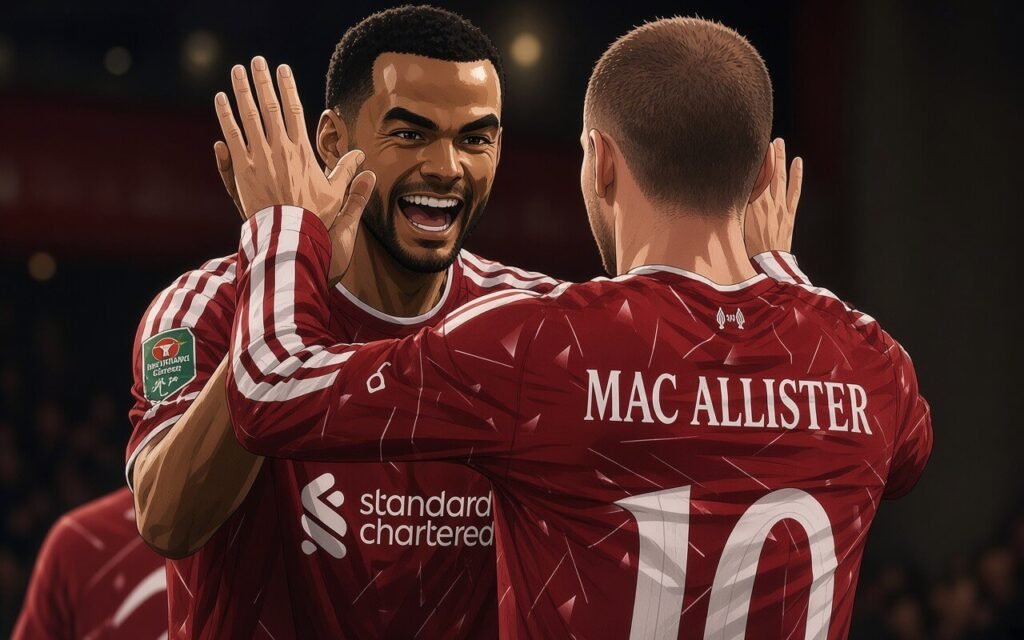
Mac Allister Punishes Tottenham’s Wastefulness
Football can be brutal when chances are missed.
Spurs had already wasted opportunities.
Then Liverpool demonstrated the difference between creating and converting.
Rio Ngumoha drove across the edge of the penalty area.
Udogie attempted to stop him.
The challenge only redirected the ball toward Alexis Mac Allister.
The Argentine opened his body and fired powerfully into the top corner.
Liverpool 1-0 Tottenham.
It was a brilliant finish.
But tactically, the goal came from something simpler.
Liverpool attacked the second ball.
Tottenham did not.
Ngumoha created the disruption.
Mac Allister anticipated where the loose ball might land.
That kind of reaction often separates elite midfielders from good ones.
Mac Allister did not wait for the attack to reset.
He recognised chaos.
He exploited it.
Tottenham’s Biggest Problem Is Becoming Obvious
This is where the conversation around Spurs has to become more direct.
They are not simply unlucky.
They are inefficient.
Before this cup tie, Tottenham had failed to score in their opening four Premier League matches, the longest goalless start to a league campaign in the club’s history.
Against Liverpool, they finally scored.
But the underlying problem remained.
They needed too many attacks to produce too little.
De Zerbi admitted as much afterwards, saying Spurs needed to shoot more accurately and finish clear situations better. Tottenham registered 17 attempts, yet again failed to translate enough of those moments into goals.
That is not a minor detail.
It is currently defining their season.
Liverpool’s Second Goal Was a Tactical Beauty
Nine minutes into the second half, Liverpool made it 2-0.
This was arguably their best team goal of the night.
James McConnell and Ngumoha helped progress the move.
Milos Kerkez found Mac Allister in space.
Instead of shooting, the Argentine played a first-time pass into Gakpo.
The Dutchman stepped inside Archie Gray and drilled his finish beyond Martin Dubravka.
This goal showed what Iraola wants from Liverpool.
Fast circulation.
Vertical progression.
Players receiving between defensive lines.
Immediate aggression once the opening appears.
The move did not rely on excessive possession.
It relied on timing.
That is a major difference.
Liverpool did not need to control every second of the match.
They needed to control the decisive seconds.
Gakpo Continues to Deliver
Cody Gakpo’s role remains important even as Liverpool’s squad evolves.
He can play wide.
He can move centrally.
He can attack the far post.
And he has the physical profile to survive games that become direct.
Against Spurs, he also added an assist for Szoboszlai’s late goal.
Liverpool cannot take that reliability for granted.
In a squad containing expensive attacking options and emerging young talents, Gakpo continues to produce.
That matters.
Cup competitions often expose players whose value is broader than simply being an automatic first-choice starter.
Gakpo is one of them.
Gallagher Finally Gives Spurs Something to Celebrate
Tottenham did not collapse after going 2-0 down.
That deserves credit.
In the 69th minute, Conor Gallagher pulled one back.
Mateus Fernandes delivered a corner.
Mamardashvili failed to deal with it convincingly.
Gallagher was waiting at the back post.
Header.
Goal.
Liverpool 2-1 Tottenham.
For Spurs, it was more than a cup goal.
It ended their wider scoring drought.
And for a few minutes, it changed the emotional direction of the match.
Tottenham pressed higher.
Liverpool became less comfortable.
Anfield became more anxious.
For the first time in the second half, Spurs looked capable of forcing extra time.
Mamardashvili Redeems Himself
The Liverpool goalkeeper had made an error for Gallagher’s goal.
He responded exactly how elite goalkeepers are supposed to respond.
Omar Marmoush found space and produced a dangerous effort that took a slight deflection.
Mamardashvili reacted quickly and produced a superb save to deny Tottenham the equaliser.
That moment mattered enormously.
At 2-2, the match changes completely.
Liverpool are suddenly under pressure.
Tottenham have momentum.
Extra time becomes realistic.
Instead, Mamardashvili kept Liverpool ahead.
Goalkeepers can make mistakes.
The best ones prevent those mistakes from defining the result.
Tottenham’s Attack Still Looks Disconnected
The finishing problem is only part of Spurs’ issue.
There is also a question of attacking relationships.
De Zerbi has numerous talented forwards.
Dominic Solanke.
Omar Marmoush.
Mohammed Kudus.
Mathys Tel.
Savio.
Yet those players still look more like individual threats than components of a functioning attacking unit.
That is understandable to a point.
Spurs underwent another major summer rebuild.
Players need time to learn each other’s movement.
But elite football rarely gives managers unlimited time.
The issue is not talent.
The issue is synchronisation.
Too often, one player attacks while the others watch.
Liverpool looked more connected.
Tottenham looked more improvised.
Liverpool’s Rotated Side Still Looked Like Liverpool
This may be the most encouraging part of the night for Iraola.
He changed 10 players.
Liverpool still retained their identity.
The pressing remained aggressive.
The transitions remained quick.
The midfield still looked to play forward.
The front line still worked without the ball.
That is a major sign of tactical progress.
A coach’s system becomes powerful when the structure survives changes in personnel.
Liverpool are beginning to reach that point under Iraola.
The first XI matters.
The squad identity matters more.
Against Tottenham, the second group looked comfortable executing the same principles.

Szoboszlai Ends the Argument in Style
Tottenham pushed for an equaliser.
That created risk.
Liverpool almost punished them when Mac Allister released Szoboszlai one-on-one, but the Hungarian’s weak finish was saved by Dubravka.
He did not waste his next opportunity.
Deep into stoppage time, Gakpo flicked the ball toward Szoboszlai.
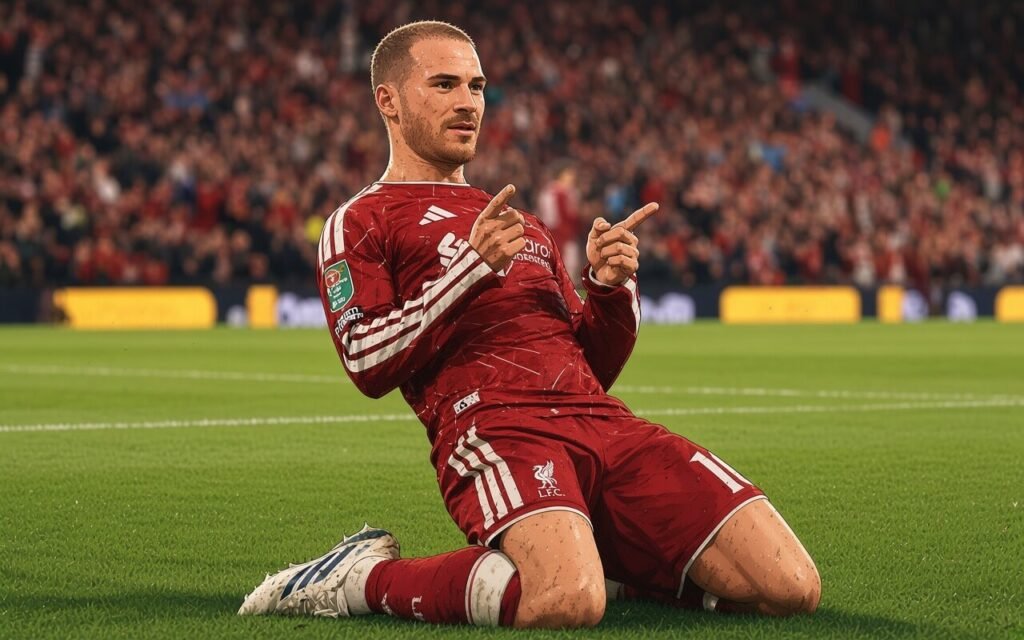
The Liverpool vice-captain controlled it with his chest and unleashed a sensational long-range strike beyond Dubravka.
Liverpool 3-1 Tottenham.
Game over.
Iraola called it a “worldie” afterwards.
That description was fair.
Some goals require tactical explanation.
Others simply require appreciation.
This was the latter.
Szoboszlai Remains Liverpool’s Big-Moment Midfielder
The goal also reinforced something Liverpool have seen repeatedly.
Szoboszlai is capable of producing decisive moments from distance.
His technique gives Liverpool an option when opponents defend compactly or when a match becomes chaotic late on.
That is enormously valuable.
Not every game can be solved through combinations inside the box.
Sometimes a midfielder has to change the geometry of the match from 25 yards.
Szoboszlai can do that.
He has already scored important goals this season, including in Liverpool’s Champions League comeback against Atlético Madrid.
Against Tottenham, he produced another.
De Zerbi’s “Unlucky” Explanation Is Starting to Wear Thin
This is where the Football Today Media view becomes less forgiving.
De Zerbi argued that the result felt unfair and that Tottenham had been unlucky across several games.
There is some truth in that.
Spurs did create chances.
They could have scored earlier.
Mamardashvili made saves.
But repeated wastefulness stops being bad luck once it becomes a pattern.
Tottenham have enough attacking quality to produce more.
They have not.
At some point, expected improvement has to become actual goals.
That responsibility sits with both the players and the coach.
De Zerbi deserves time.
But he also needs solutions.
Liverpool’s Clinical Edge Was the Real Difference
Liverpool did not dominate every phase.
They did not have to.
Their advantage was efficiency.
Tottenham created.
Liverpool converted.
Mac Allister punished a loose ball.
Gakpo finished a well-built move.
Szoboszlai produced a spectacular third.
Three goals.
Three different attacking situations.
That variety is important.
It shows Liverpool can score from chaos, structured possession and individual brilliance.
That makes them difficult to defend.
Football Today Media Verdict
Tottenham will leave Anfield talking about missed chances.
Liverpool will leave talking about the next round.
That tells the story.
Spurs played some good football.
They created enough to make the match uncomfortable.
They even pushed Liverpool late after Gallagher’s goal.
But football is not awarded for territory or aesthetics.
It is awarded for goals.
Liverpool understood that better.
Mac Allister punished the first real opening.
Gakpo finished a sharp second.
Szoboszlai ended the night with brilliance.
And between those moments, Liverpool’s young players showed exactly why Iraola trusts them.
Koumas led the press.
Ngumoha carried the ball fearlessly.
McConnell and Nyoni competed.
That may be the biggest positive of all.
Liverpool changed 10 players and still looked like Liverpool.
Tottenham changed eight and still looked like a team searching for an identity in the final third.
That difference is not accidental.
It is the difference between having talented players and having a functioning system.
Liverpool currently have both.
Spurs, for now, have only one.
Sources
Tottenham Hotspur — Reds Progress at Anfield
Official Tottenham match report covering the chances created, all four goals, line-up changes and Gallagher’s second-half response.
Read Tottenham’s official match report
Liverpool FC — Liverpool 3-1 Tottenham: Opta Stats
Official Liverpool statistical recap confirming the scorers and Carabao Cup result.
Read Liverpool’s official stats recap
The Guardian — Szoboszlai Screamer Seals Liverpool Progress
Detailed independent report with tactical context, major chances and post-match reaction from Iraola and De Zerbi.
Read The Guardian match report
Reuters — Arsenal and Liverpool Progress in League Cup
Reuters confirms Liverpool’s 3-1 win, the three scorers and Tottenham’s continuing difficult start.
Read the Reuters League Cup roundup